Larynograph
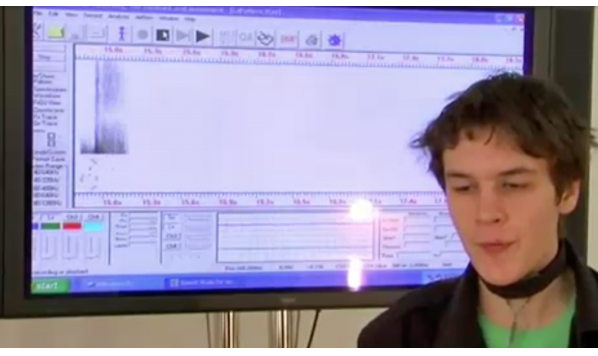
您的浏览器不支持 HTML5 视频。 I'm David Howard from york and we're company at the Dance center in London to look at B-boxing Let's look briefly at what the human instrument offers to the B-boxer because the human vocal instrument is the same for all of us We've all got what is basically a buzzer sounding something like this in our throat This is the vibrating vocal folds in the larynx so this can substitute for the larynx. And it just reminds us that in normal speech and singing we just have a buzzer And the buzzer in the neck is playing into a tube the mouth tube and sometimes coupled into it the nose tube But to illustrate the tubes, I have here two acrylic tubes,the low ones for the vowel ah and the upper ones for the vowel e and you can see the big difference for e the tube is very constricted towards the lip end whereas for r it's very open confirm that these are indeed the vowels.And Therefore all these guys have to play with is a buzzer and a tube we're going to be monitoring two things The first is what the vocal folds in the larynx are actually doing.And this is done electrically with two small electrodes that go,Round the outside of the neck with a band that holds them onto the neck.the other signal will be picking up is from a small microphone,which is clipped onto this Wire,And the output from that will let us see approximately what each of your ears is sending your brain,as you listen to this sound.The beats.Just do that. First thing you did.Are these two vertical lines?Because one of the things that or.Sound, which are the constants in English do.Is create energy at all frequencies in a vertical lines,There very clearly Enter fide.And you can also of course understand why the ear can pick them out,if we move on a bit to where the rhythm became a little bit more involved.Here we go,Now see the regularity in the rhythm which of course under pins all Types of music, but particularly boxing. Anything with a drum beat has a regular structure.So these are the shorts so
收录时间:2020-02-19T07:15:59Z
使用资料正文
I'm David Howard from york and we're company at the Dance center in London to look at B-boxing Let's look briefly at what the human instrument offers to the B-boxer because the human vocal instrument is the same for all of us We've all got what is basically a buzzer sounding something like this in our throat This is the vibrating vocal folds in the larynx so this can substitute for the larynx. And it just reminds us that in normal speech and singing we just have a buzzer And the buzzer in the neck is playing into a tube the mouth tube and sometimes coupled into it the nose tube But to illustrate the tubes, I have here two acrylic tubes,the low ones for the vowel ah and the upper ones for the vowel e and you can see the big difference for e the tube is very constricted towards the lip end whereas for r it's very open confirm that these are indeed the vowels.And Therefore all these guys have to play with is a buzzer and a tube we're going to be monitoring two things The first is what the vocal folds in the larynx are actually doing.And this is done electrically with two small electrodes that go,Round the outside of the neck with a band that holds them onto the neck.the other signal will be picking up is from a small microphone,which is clipped onto this Wire,And the output from that will let us see approximately what each of your ears is sending your brain,as you listen to this sound.The beats.Just do that. First thing you did.Are these two vertical lines?Because one of the things that or.Sound, which are the constants in English do.Is create energy at all frequencies in a vertical lines,There very clearly Enter fide.And you can also of course understand why the ear can pick them out,if we move on a bit to where the rhythm became a little bit more involved.Here we go,Now see the regularity in the rhythm which of course under pins all Types of music, but particularly boxing. Anything with a drum beat has a regular structure.So these are the shorts sounds and this one which is longer stretched out That's the I think it was a So there's the at the beginning, followed by a long s.Sound as in freddie. What are the sounds can we make?Um Well That's the crab scratch, which is it works.Kind of like the sea crab scratch. Yeah Right? Okay.Let's look at that That long sound is evident here.There's an interesting thing going on here is there And it's on the next one too You can see a descending pitch there So Somewhere in your cavity,And I guess it's where your finger is You're changing the size of the cavity because if you change the cavity size you will change it's acoustic properties in that way so.That That is.Really quite extraordinary.Because those.Sounds, which I think are.Putting your larynx high and then moving the larynx down you're creating an airstream by having an air column between the lungs and the mouth moving the larynx up and simply moving the larynx down on this column of air So you're creating your own Air flow that way. I think he's coming from that.And Interestingly which you can hear as well. And they are very regularly.Set up an about what? 240 going down to 120. So it's not to drop that.Shooting downs, but you are able to repeat it.So what we conclude, well we must remember that we've got a tube and the buzzer This is all they have available to them.The buzzer gives you the opportunity to pitch things.So your trumpet sounds particular, and some of those other place sounds But the tube is being used in a most remarkable set of ways which are most un speech like so a lot of the use of the front of the mouth is not using shapes that we use when we speak But the real thing I think that singles beat boxing out from anything we do vocally normally is the speed at which these changes are made.And the really tight rhythm that's adopted to get these musical sounds going in a way that makes you wanna get up and dance