Quantitative analysis of ultrasound data collected with and without head stabilisation
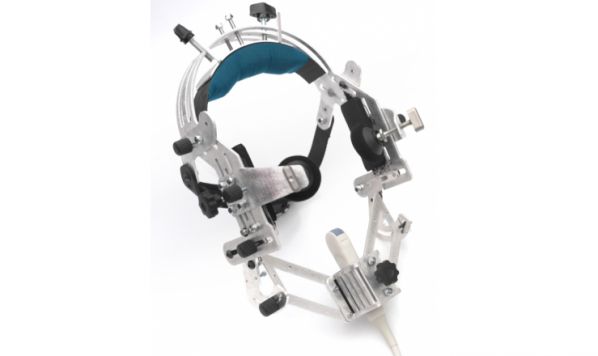
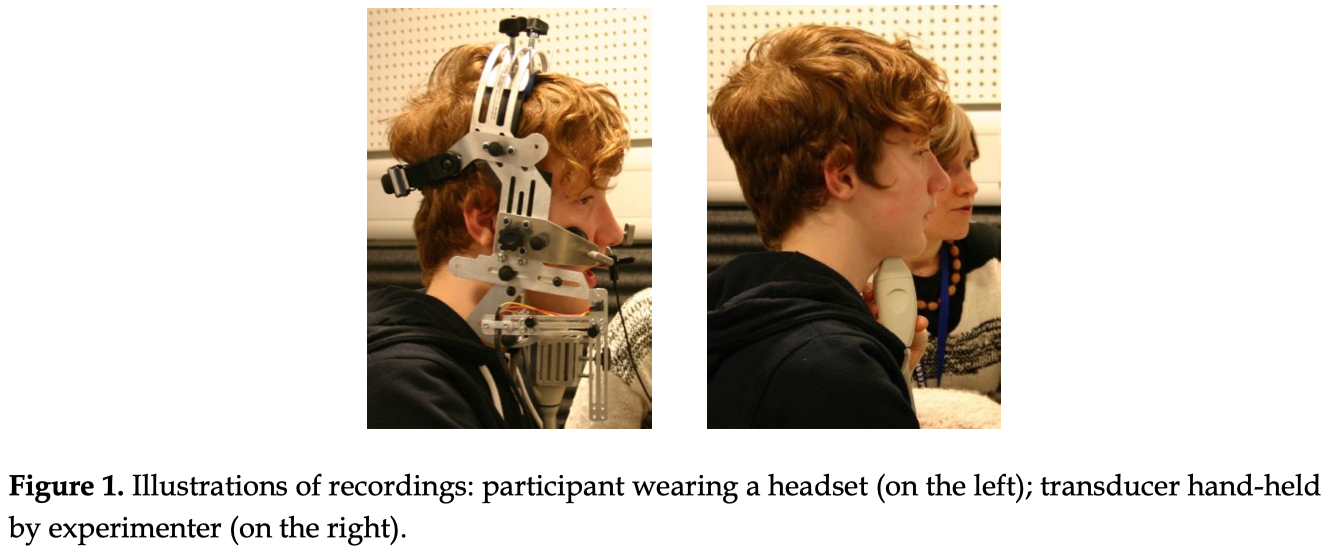
Quantitative analysis of ultrasound data collected with and without head stabilisation Natalia Zharkova and Nigel Hewlett Clinical Audiology, Speech and Language Research Centre, Queen Margaret University Ultrasound research on speech production in typical speakers has long used quantitative measurements (Stone 2005). By contrast, previous studies using ultrasound tongue imaging with clinical populations have generally reported qualitative information on tongue movement (e.g., Bacsfalvi & Bernhardt 2011; Bressmann et al. 2011). The development of quantitative measures for use in the clinic has largely been hindered by the need to stabilise the ultrasound transducer in relation to the head of the speaker. The aim of the present study is to explore the applicability of quantitative measurements of stabilisation-free tongue movement data, by comparing ultrasound data collected with and without head stabilisation. The stabilisation device used in the study is a headset holding the transducer (Articulate Instruments Ltd 2008). Ultrasound tongue movement data synchronised with acoustic data from ten adolescent speakers (aged between 13 years 0 months and 13 years 11 months) were recorded and analysed. The speakers produced the syllables /pa/ and /pi/ in the carrier phrase “It’s a ..., Pam”. Each target was repeated five times, and the tokens were presented in random order. The ultrasound fame rate was 100 Hz. Recordings were made in a sound-treated studio. Each participant performed the task two times. The first time was recorded while the participant wore the headset, and the second time no headset was worn, instead the transducer was hand-held by the experimenter (see Figure 1). The data collection without the headset was video recorded. Midsagittal tongue curves at /p/ mid-closure were compared across the two conditions (headset versus non-headset) and across vowel contexts (/a/ versus /i/). First, the Nearest Neighbour calculations (Zharkova & Hewlett 2009) were perfo
收录时间:2020-02-06T09:33:11Z
使用资料正文
Quantitative analysis of ultrasound data collected with and without head stabilisation
Natalia Zharkova and Nigel Hewlett
Clinical Audiology, Speech and Language Research Centre, Queen Margaret University
Ultrasound research on speech production in typical speakers has long used quantitative measurements (Stone 2005). By contrast, previous studies using ultrasound tongue imaging with clinical populations have generally reported qualitative information on tongue movement (e.g., Bacsfalvi & Bernhardt 2011; Bressmann et al. 2011). The development of quantitative measures for use in the clinic has largely been hindered by the need to stabilise the ultrasound transducer in relation to the head of the speaker. The aim of the present study is to explore the applicability of quantitative measurements of stabilisation-free tongue movement data, by comparing ultrasound data collected with and without head stabilisation. The stabilisation device used in the study is a headset holding the transducer (Articulate Instruments Ltd 2008).
Ultrasound tongue movement data synchronised with acoustic data from ten adolescent speakers (aged between 13 years 0 months and 13 years 11 months) were recorded and analysed. The speakers produced the syllables /pa/ and /pi/ in the carrier phrase “It’s a ..., Pam”. Each target was repeated five times, and the tokens were presented in random order. The ultrasound fame rate was 100 Hz. Recordings were made in a sound-treated studio. Each participant performed the task two times. The first time was recorded while the participant wore the headset, and the second time no headset was worn, instead the transducer was hand-held by the experimenter (see Figure 1). The data collection without the headset was video recorded.
Midsagittal tongue curves at /p/ mid-closure were compared across the two conditions (headset versus non-headset) and across vowel contexts (/a/ versus /i/). First, the Nearest Neighbour calculations (Zharkova & Hewlett 2009) were performed. They involved computing across-set (AS) distances between two sets of curves for /p/ (one set in the context of /a/ and one set in the context of /i/) and within-set (WS) distances for each of the two sets of curves. We hypothesised that there would be an effect of condition on both AS and WS distances. We expected to observe a significant vowelrelated difference between the two sets of consonant tongue curves (i.e., significantly greater AS distances than WS distances for each vowel context) in the headset condition, and no such difference in the no-headset condition. Next, two measures were taken which characterise the tongue shape through ratios based on a single curve (Zharkova 2013): Dorsum Excursion Index (DEI) and Tongue Constraint Position Index (TCPI). We predicted no effect of condition and a significant effect of vowel context on both indices.
There was a significant effect of condition on AS and WS distances (p < 0.01). WS distances were consistently larger in the no-headset condition for every speaker, while for AS distances there was a noticeable inter-speaker variation. The effect of condition on DEI was not significant for the data pooled across vowel contexts and for the data from the context of /i/ only, but the effect was significant for the data from the context of /a/ (at p < 0.01). The effect of condition on TCPI was not significant either for the data pooled across the two vowel contexts or for the data from the two vowel contexts analysed separately. For both headset and no-headset conditions, a significant vowel-related difference in the consonant tongue curves was observed when comparing AS distances to WS distances (p < 0.01). The vowel context effect was significant in both headset and no-headset conditions for both DEI and TCPI (p < 0.01), with all speakers showing larger values in the context of /i/ for both indices.
As predicted, the measures based on calculating absolute distances between tongue curves were affected by whether or not the speakers wore the headset. Measures based on single curves have previously been found to be unaffected by changes in transducer placement (Ménard et al. 2012), and our findings were largely consistent with this pattern. However there was a vowel-specific difference for DEI, with the no-headset condition in the context of /a/ showing, on average, smaller values than the headset condition. This difference was not uniform across speakers. Only five speakers had smaller DEI values in the no-headset condition in this vowel context, however the difference across conditions tended to be particularly large in four of these speakers. Future work will include analysing tongue curves for other consonants in the headset and no-headset conditions, to investigate whether the same effect on DEI in the context of /a/ is observed regardless of the consonant identity.
TCPI was the only measure unaffected by the headset/no-headset condition in the two vowel contexts pooled and in each vowel context analysed separately. This finding suggests that TCPI can be used for comparing tongue behaviour in speakers who can wear the headset and speakers who cannot wear it, for example, young children. Our results also show that relative measurements, such as comparisons of index values within speaker across vowel contexts, provide more consistent results across speakers than comparisons of absolute index values across speakers. Variability in absolute values found in this study is in agreement with previous articulatory findings (e.g., Gibbon et al. 2007; Liker & Gibbon 2008).
References
Articulate Instruments Ltd (2008). Ultrasound Stabilisation Headset Users Manual: Revision 1.4. Edinburgh, UK: Articulate Instruments Ltd.
Bacsfalvi, P. & Bernhardt, B. M. (2011). Long-term outcomes of speech therapy for seven adolescents with visual feedback technologies: ultrasound and electropalatography. Clinical Linguistics & Phonetics, 25, 1034-1043.
Bressmann, T., Radovanovic, B., Kulkarni, G.V., Klaiman, P. & Fisher, D. (2011). An ultrasonographic investigation of cleft-type compensatory articulations of voiceless velar stops. Clinical Linguistics & Phonetics, 25, 1028-1033.
Gibbon, F., Lee, A. & Yuen, I. (2007a). Tongue-palate contact during bilabials in normal speech. Cleft Palate-Craniofacial Journal, 44, 87–91.
Liker, M. & Gibbon, F. (2008). Tongue palate contact patterns of velar stops in normal adult English speakers. Clinical Linguistics and Phonetics, 22, 137–148.
Ménard, L., Aubin, J., Thibeault, M., & Richard, G. (2012). Comparing tongue shapes and positions with ultrasound imaging: a validation experiment using an articulatory model. Folia Phoniatrica et Logopaedica, 64, 64–72.
Stone, M. (2005). A guide to analyzing tongue motion from ultrasound images. Clinical Linguistics and Phonetics, 19, 455-502.
Zharkova, N. (2013). Using ultrasound to quantify tongue shape and movement characteristics. The Cleft Palate-Craniofacial Journal, 50, 76-81.
Zharkova, N., & Hewlett, N. (2009). Measuring lingual coarticulation from midsagittal tongue contours:Description and example calculations using English /t/ and /*/. Journal of Phonetics, 37, 248256.