An Exploratory Ultrasound Investigation of Emphatic Articulation in Cairene Arabic
An Exploratory Ultrasound Investigation of Emphatic Articulation in Cairene Arabic Natalia Lapinskaya University of Toronto Secondary articulation of ‘emphatic’ consonants of Arabic has been described as lowering of the tongue in the palatal region and retraction of the tongue root towards the pharynx (pharyngealization; Ali & Daniloff, 1972). Previous investigations of emphatic articulations (including ultrasound, such as Zeroual et al., 2011) have been primarily qualitative in nature. This study presents an exploratory quantitative investigation of emphatic articulation, employing Smoothing Spline Analysis of Variance (SS-ANOVA; Davidson, 2006) to statistically evaluate the differences in position between individual sections of the tongue during the articulation of plain and emphatic consonants. A female native speaker of Cairene Arabic was recorded pronouncing multiple repetitions of meaningful words containing plain /t, d, s, k/ and emphatic /tˤ, dˤ, sˤ, kˤ/ in the context /a_a/. 86 tokens were analyzed in total, 10-12 per consonant. Scans were performed with a 7.5 MHz SeeMore USB ultrasound probe by Interson, with scanning depth set to 10cm and a scanning rate of 15 frames per second. The audio signal was captured using an AT831b lavalier microphone and a Sound Devices USBPre2 pre-amplifier with a sampling rate of 48 kHz. Both were connected via USB to an Acer Aspire 5755 laptop computer with SeeMore software (version 1.03.02) installed. Tongue contours from frames corresponding to the greatest constriction during the consonant interval were traced semiautomatically using EdgeTrak software (Li et al., 2005), manually adjusted when necessary, and exported for analysis as a set of 100 XY coordinates. SS-ANOVA was used to determine which sections of the tongue contours differ significantly by comparing 95% Bayesian confidence intervals constructed around smoothing splines best fitting the plain and emphatic data sets for each consonant (Davidson, 2006). The result
收录时间:2020-02-06T09:49:29Z
使用资料正文
An Exploratory Ultrasound Investigation of Emphatic
Articulation in Cairene Arabic
Natalia Lapinskaya
University of Toronto
Secondary articulation of ‘emphatic’ consonants of Arabic has been described as lowering of the tongue in the palatal region and retraction of the tongue root towards the pharynx (pharyngealization; Ali & Daniloff, 1972). Previous investigations of emphatic articulations (including ultrasound, such as Zeroual et al., 2011) have been primarily qualitative in nature. This study presents an exploratory quantitative investigation of emphatic articulation, employing Smoothing Spline Analysis of Variance (SS-ANOVA; Davidson, 2006) to statistically evaluate the differences in position between individual sections of the tongue during the articulation of plain and emphatic consonants.
A female native speaker of Cairene Arabic was recorded pronouncing multiple repetitions of meaningful words containing plain /t, d, s, k/ and emphatic /tˤ, dˤ, sˤ, kˤ/ in the context /a_a/. 86 tokens were analyzed in total, 10-12 per consonant. Scans were performed with a 7.5 MHz SeeMore USB ultrasound probe by Interson, with scanning depth set to 10cm and a scanning rate of 15 frames per second. The audio signal was captured using an AT831b lavalier microphone and a Sound Devices USBPre2 pre-amplifier with a sampling rate of 48 kHz. Both were connected via USB to an Acer Aspire 5755 laptop computer with SeeMore software (version 1.03.02) installed. Tongue contours from frames corresponding to the greatest constriction during the consonant interval were traced semiautomatically using EdgeTrak software (Li et al., 2005), manually adjusted when necessary, and exported for analysis as a set of 100 XY coordinates. SS-ANOVA was used to determine which sections of the tongue contours differ significantly by comparing 95% Bayesian confidence intervals constructed around smoothing splines best fitting the plain and emphatic data sets for each consonant (Davidson, 2006).
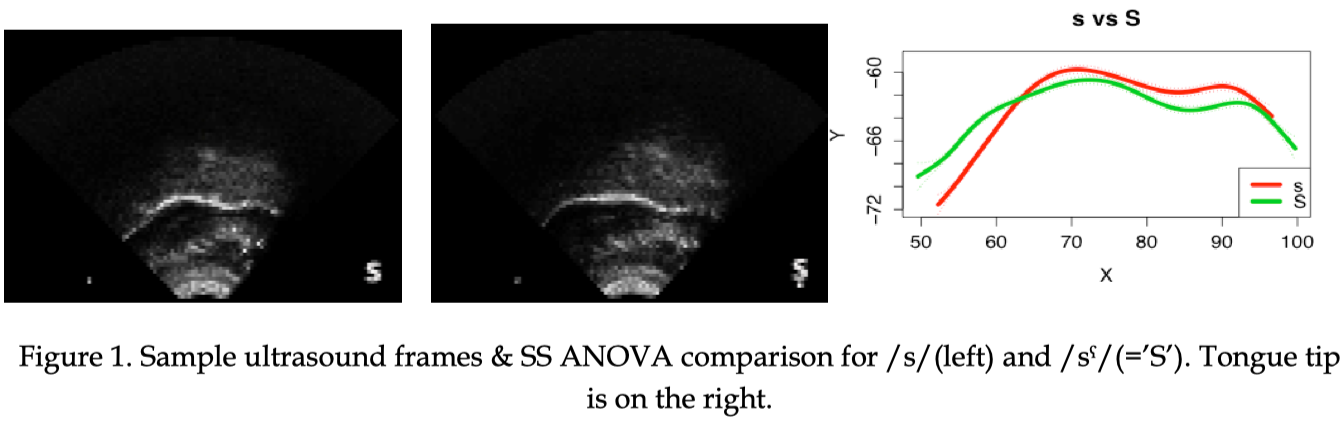
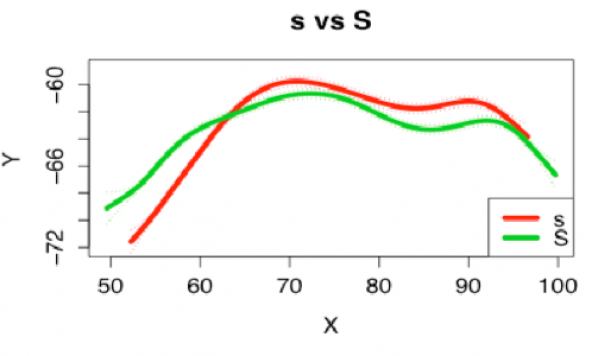
The results showed significant lowering of the tongue in the palatal region during the production of all emphatics, compared to non-emphatic counterparts. The posterior tongue dorsum was significantly retracted, as illustrated in Figure 1. This is consistent with previous research involving ultrasound (Zeroual et al., 2011), cinefluorography (Ali & Daniloff, 1972), videofluoroscopy (Al-Tamimi et al., 2009), and other methods. The position of the most anterior section of the tongue was not found to be significantly different for any plain/emphatic pair. The shape of the tongue, aside from the retracted portion, was found to be nearly identical for plain and emphatic coronal segments (/t, d, s/). This is in contrast with the view that the point of tongue-palate contact is retracted for the emphatics, as previously suggested by Al-Ani (1970), among others. In sum, the results of this study suggest that quantitative ultrasound analysis of Arabic emphatics can be used successfully to evaluate previous generalizations about these sounds.
References
Al-Ani, S. H. (1970). Arabic phonology: An acoustical and physiological investigation. The Hague: Mouton.
Al-Tamimi F., Alzoubi F., Tarawnah R, A. (2009). Videofluoroscopic Study of the Emphatic Consonants in Jordanian Arabic. Folia Phoniatrica et Logopaedica, 61, 247-253
Ali, L. & Daniloff, R. (1972). A contrastive cinefluorographic investigation of the articulation of emphatic-non emphatic cognate consonants. Studia Linguistica, 26, 81-105.
Davidson, L. (2006). Comparing tongue shapes from ultrasound imaging using smoothing spline analysis of variance. Journal of the Acoustical Society of America, 120, 407–415.
Li, M., Kambhamettu, C., & Stone, M. (2005). Automatic contour tracking in ultrasound images. Clinical Linguistics and Phonetics, 19, 545–554.
Zeroual, C., Esling, J. H., & Hoole, P. (2011). EMA, endoscopic, ultrasound, and acoustic study of two secondary articulations in Moroccan Arabic. In Hassan, Z.M., Heselwood, B., (Eds.) Instrumental Studies in Arabic Phonetics (pp. 277-301). Philadelphia: John Benjamins North America.