Contextual patterns of /l/-darkening in accents of English
Contextual patterns of /l/-darkening in accents of English Danielle Turton University of Manchester The phenomenon of /l/-darkening, whereby /l/ is produced with a delayed tongue-tip gesture, exhibits a remarkable amount of variation depending on its position in the word or phrase. Traditionally, it is said that light [l] occurs in onsets (e.g. light) and dark [l+] in codas (e.g. dull; Giegerich 1992; Halle & Mohanan 1985), but many studies report varying distributions of light and dark /l/ in different morphosyntactic environments. Table 1 summarises the outcome of previous studies on /l/darkening in American varieties, alongside the pattern reported in RP. Beyond this variation in morphosyntactic conditioning, some dialects have been reported to show no allophonic distinction between light and dark /l/. The variety spoken in Manchester is said to exhibit dark [l+] in all contexts (Cruttenden 2008; Kelly & Local 1986), whilst North-East /l/s are reported as being clear in all positions (Cruttenden 2008; Wells 1982). Although such reports are widespread in the existing literature, they are yet to be vindicated by instrumental articulatory evidence, or even acoustic data. This paper presents ultrasound data collected to test whether the aforementioned dialects of British English indeed display the reported patterns of /l/-darkening, and whether British English dialects show any evidence of morphosyntactic conditioning of /l/-darkening, as previously reported for American English. Speakers of RP, and speakers from Manchester and Middlesbrough were recorded producing /l/ in five contexts: word-initial, word-medial before a vowel in the same stem, word-medial before a suffixal vowel, word-final prevocalic, and phrase-final, corresponding to the headings in Table 1. The RP speaker illustrated in Figure 1 shows the pattern of /l/-darkening reported by Cruttenden (2008), with [l+] only in non-prevocalic position: the backed tongue body, reduced tongue-tip gesture, and retracte
收录时间:2020-02-06T10:01:20Z
使用资料正文
Contextual patterns of /l/-darkening in accents of English
Danielle Turton University of Manchester
The phenomenon of /l/-darkening, whereby /l/ is produced with a delayed tongue-tip gesture, exhibits a remarkable amount of variation depending on its position in the word or phrase. Traditionally, it is said that light [l] occurs in onsets (e.g. light) and dark [l+] in codas (e.g. dull; Giegerich 1992; Halle & Mohanan 1985), but many studies report varying distributions of light and dark /l/ in different morphosyntactic environments. Table 1 summarises the outcome of previous studies on /l/darkening in American varieties, alongside the pattern reported in RP.
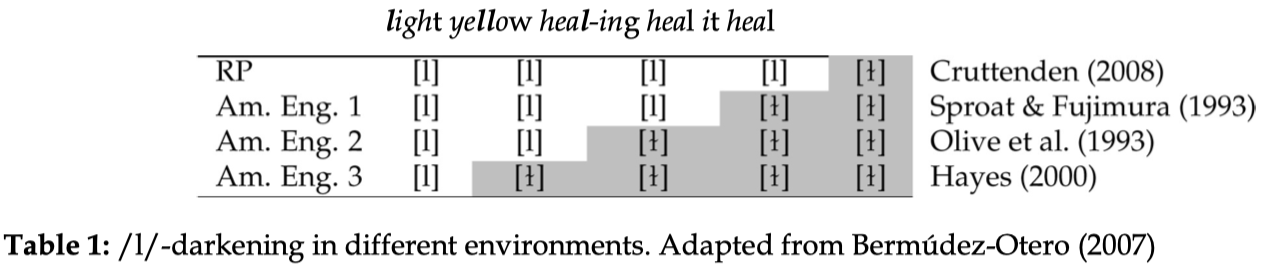
Beyond this variation in morphosyntactic conditioning, some dialects have been reported to show no allophonic distinction between light and dark /l/. The variety spoken in Manchester is said to exhibit dark [l+] in all contexts (Cruttenden 2008; Kelly & Local 1986), whilst North-East /l/s are reported as being clear in all positions (Cruttenden 2008; Wells 1982). Although such reports are widespread in the existing literature, they are yet to be vindicated by instrumental articulatory evidence, or even acoustic data.
This paper presents ultrasound data collected to test whether the aforementioned dialects of British English indeed display the reported patterns of /l/-darkening, and whether British English dialects show any evidence of morphosyntactic conditioning of /l/-darkening, as previously reported for American English.
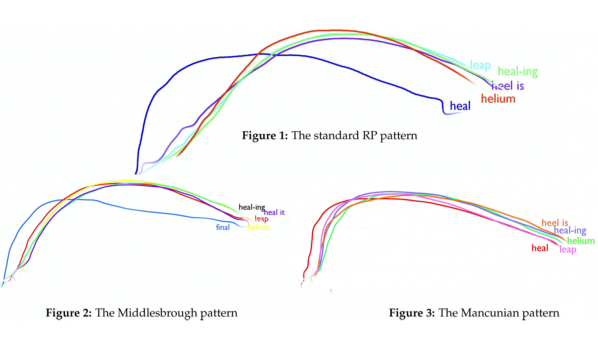
Speakers of RP, and speakers from Manchester and Middlesbrough were recorded producing /l/ in five contexts: word-initial, word-medial before a vowel in the same stem, word-medial before a suffixal vowel, word-final prevocalic, and phrase-final, corresponding to the headings in Table 1. The RP speaker illustrated in Figure 1 shows the pattern of /l/-darkening reported by Cruttenden (2008), with [l+] only in non-prevocalic position: the backed tongue body, reduced tongue-tip gesture, and retracted tongue root typical of [l+] are found in prepausal heal only, and not in heal it. This demonstrates that there exist varieties of RP that do display very limited /l/-darkening, with a phrase-level alternation between light [l] prevocalically, and dark [l+] phrase-finally.
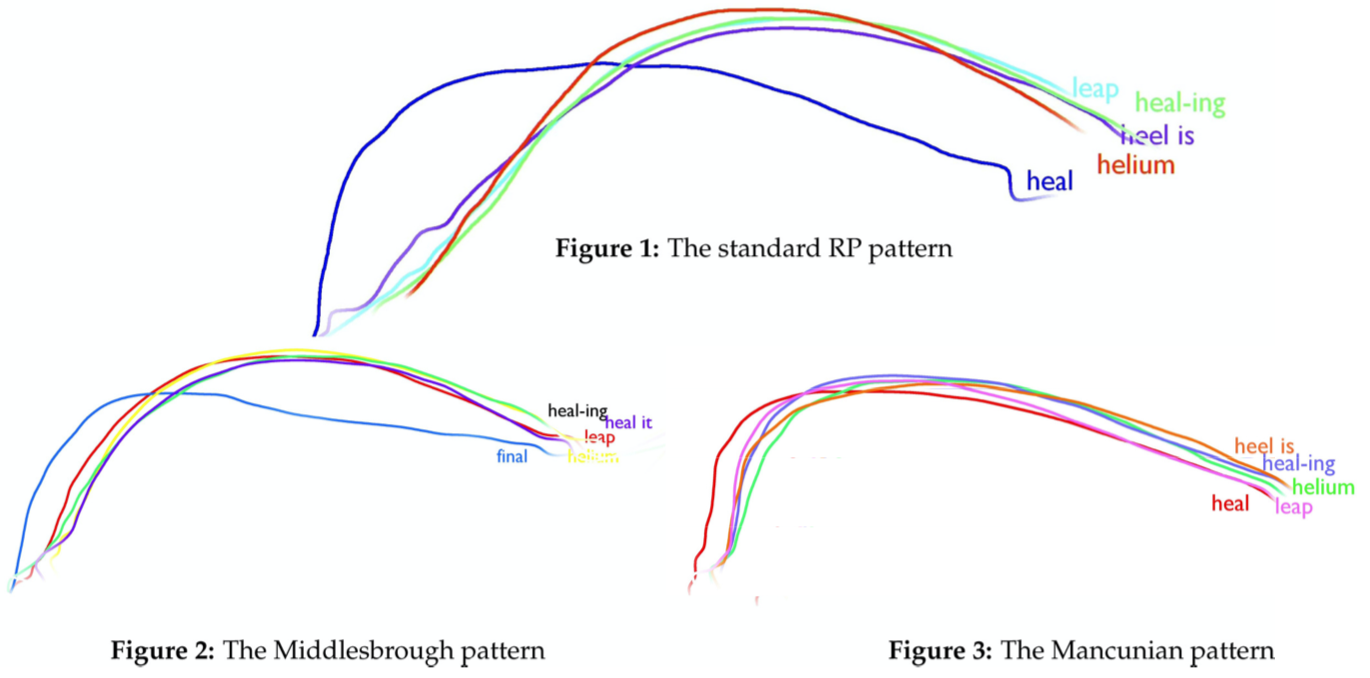
The Middlesbrough speaker in Figure 2 shows the same distribution as RP, with phrase-final /l/ significantly backed in comparison with the four other phonological contexts (all statistical tests performed in the Articulate Assistant Advanced spline workspace with two-way t-test function; Wrench 2007). The Mancunian data (Figure 3) may appear to corroborate the claims of no allophonic distinction between initial and final /l/, however, the ultrasound imaging shows that phrase-final /l/ in the Mancunian data has marginal but significant tongue root backing (p < 0.05) compared with the other contexts.
The data from the three dialects provide hitherto absent instrumental evidence for a morphosyntactically conservative distribution of /l/-darkening, documenting an earlier stage of a wellreported sound change. Moreover, the fact that the three varieties show similarities in terms of distribution, but wide-ranging differences in terms of realisation raises important questions about the abstract nature of allophonic categories.