Velar coarticulation and tongue twisters in people who stutter 1: Fluent Utterances
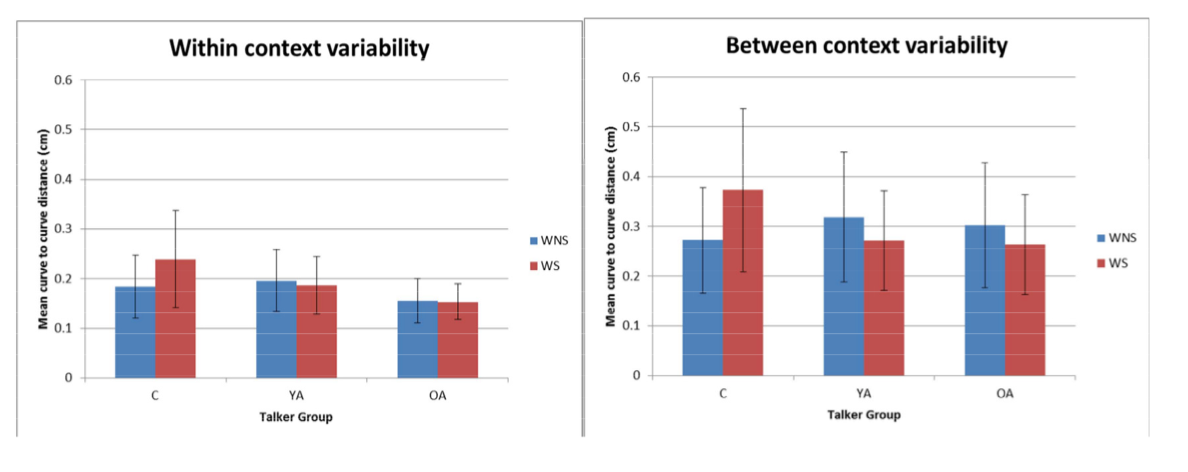
Velar coarticulation and tongue twisters in people who stutter 1: Fluent Utterances Stefan A. Frisch, Alissa Belmont, & Nathan D. Maxfield University of South Florida Introduction This poster will present data from across the lifespan for typical control participants and people who stutter. The task involved repeating velarvowel consonant combinations in a carrier sentence (e.g. Say a cope again, following Wodzinski & Frisch 2005 ASA presentation) followed by a set of tongue twisters designed to induce velaralveolar errors (e.g. top cap cop tab, following Pouplier & Goldstein 2005). The goal of the study is to determine whether there is evidence for differences in the speech production process for people with stuttering even during fluent and otherwise normal sounding utterances. Analysis Data for velarvowel coarticulation were analyzed using the Articulate Assistant Advanced software (Articulate Instruments, 2012) to create tongue traces. Tongue traces were then analyzed following the procedures for average of the nearest neighbor pointtopoint distance between curves (Zharkova & Hewlett 2009). Analysis of average nearest neighbor pointtopoint distance between tongue traces was conducted within a context as a measure of variability (e.g. a speaker’s utterance of /ke/ compared to the speaker’s other utterances of /ke/) and between contexts as a measure of coarticulation (e.g. a speaker’s utterance of /ke/ compared to the speaker’s other utterances of /ki/, /ko/, /ku/, etc). Participants 30 speakers so far, 5 each from three age groups (children 812, young adults 1839, older adults 5065) and two populations (people with stuttering and typically fluent talkers). Results Children with stuttering had greater variability in productions both within and between contexts (less articulatory consistency and/or more holistic utterances). There were also trends toward older adults having less variability within context (more consistent repetitions) and adult stutterers having le
收录时间:2020-02-06T10:16:55Z
使用资料正文
Velar coarticulation and tongue twisters in people who stutter 1: Fluent Utterances
Stefan A. Frisch, Alissa Belmont, & Nathan D. Maxfield
University of South Florida
Introduction
This poster will present data from across the lifespan for typical control participants and people who stutter. The task involved repeating velarvowel consonant combinations in a carrier sentence (e.g. Say a cope again, following Wodzinski & Frisch 2005 ASA presentation) followed by a set of tongue twisters designed to induce velaralveolar errors (e.g. top cap cop tab, following Pouplier & Goldstein 2005). The goal of the study is to determine whether there is evidence for differences in the speech production process for people with stuttering even during fluent and otherwise normal sounding utterances.
Analysis
Data for velarvowel coarticulation were analyzed using the Articulate Assistant Advanced software (Articulate Instruments, 2012) to create tongue traces. Tongue traces were then analyzed following the procedures for average of the nearest neighbor pointtopoint distance between curves (Zharkova & Hewlett 2009). Analysis of average nearest neighbor pointtopoint distance between tongue traces was conducted within a context as a measure of variability (e.g. a speaker’s utterance of /ke/ compared to the speaker’s other utterances of /ke/) and between contexts as a measure of coarticulation (e.g. a speaker’s utterance of /ke/ compared to the speaker’s other utterances of /ki/, /ko/, /ku/, etc).
Participants
30 speakers so far, 5 each from three age groups (children 812, young adults 1839, older adults 5065) and two populations (people with stuttering and typically fluent talkers).
Results
Children with stuttering had greater variability in productions both within and between contexts (less articulatory consistency and/or more holistic utterances). There were also trends toward older adults having less variability within context (more consistent repetitions) and adult stutterers having less variability between contexts (reduced coarticulatory variability).