An ultrasound study of oral and nasal central vowels in Brazilian Portuguese
An ultrasound study of oral and nasal central vowels in Brazilian Portuguese Lilian C Kuhn Pereira a, Maria A F Svicero, Sandra Madu ureira, Zuleica Camargo Integrated Acoustic A Analisys an Cognition Laboratory(LIAAC) – Pontifical Catho olic University of Sao Paulo (PUCSP), Sao Paulo, Brazil Goal The ultrasound technique is s a non-invasive way of investigating speech so ound productions and describing them. This s study aims at characterizing, by means of ultras sound techniques and acoustic analysis, the d differences in tongue position between the centraal oral and nasal vowels in syllable stressed d position and the central vowel in stressed and unstressed positions in Brazilian Portuguuese (BP). It is also concerned with approaching g its findings with the results of BP vowel desc criptions based on cine-radiographic data (Matta MMachado, 1981), acoustic analysis (Mendes, 2003), MRI (Demolin & Medeiros, 2006; Gregioo,2006), and US (Berti, 2010; Svicero, 2012). Methods Speech samples from 2 female adult speakers of BP, with no speech, voice or auditory disorders, were collected. The corpora comprised eight non-sense words: /fapa/, /fapi/, /fapu/, /fipa/, /fupa/, /fãpa/, /fãpi/, /fãpu/ inserted in carrier sentences. The data were recorded at the Speech Science Research Laboratory at Queen Margaret University. A Concept M6 Digital Ultrasonic Diagnostic Imaging System, with a 120-degree transducer, was used to capture data. The ultrasound system, in conjunction with the AAA software, captured 30 frames per second. Each recording session lasted for 30 minutes. The subjects performed a reading task and repeated the sentences, which were randomly presented four times. Simultaneous recordings of the ultrasound and the audio data, using the Articulate Assistant Advanced (AAA) software, were made. The speakers wore adjustable aluminum headsets during the whole recording session. This device, which was developed at QMU, is necessary to maintain the US probe in a fixed po
收录时间:2020-02-07T01:47:31Z
使用资料正文
An ultrasound study of oral and nasal central vowels in Brazilian Portuguese
Lilian C Kuhn Pereira a, Maria A F Svicero, Sandra Madu ureira, Zuleica Camargo
Integrated Acoustic A Analisys an Cognition Laboratory(LIAAC) – Pontifical
Catho olic University of Sao Paulo (PUCSP), Sao Paulo, Brazil
Goal
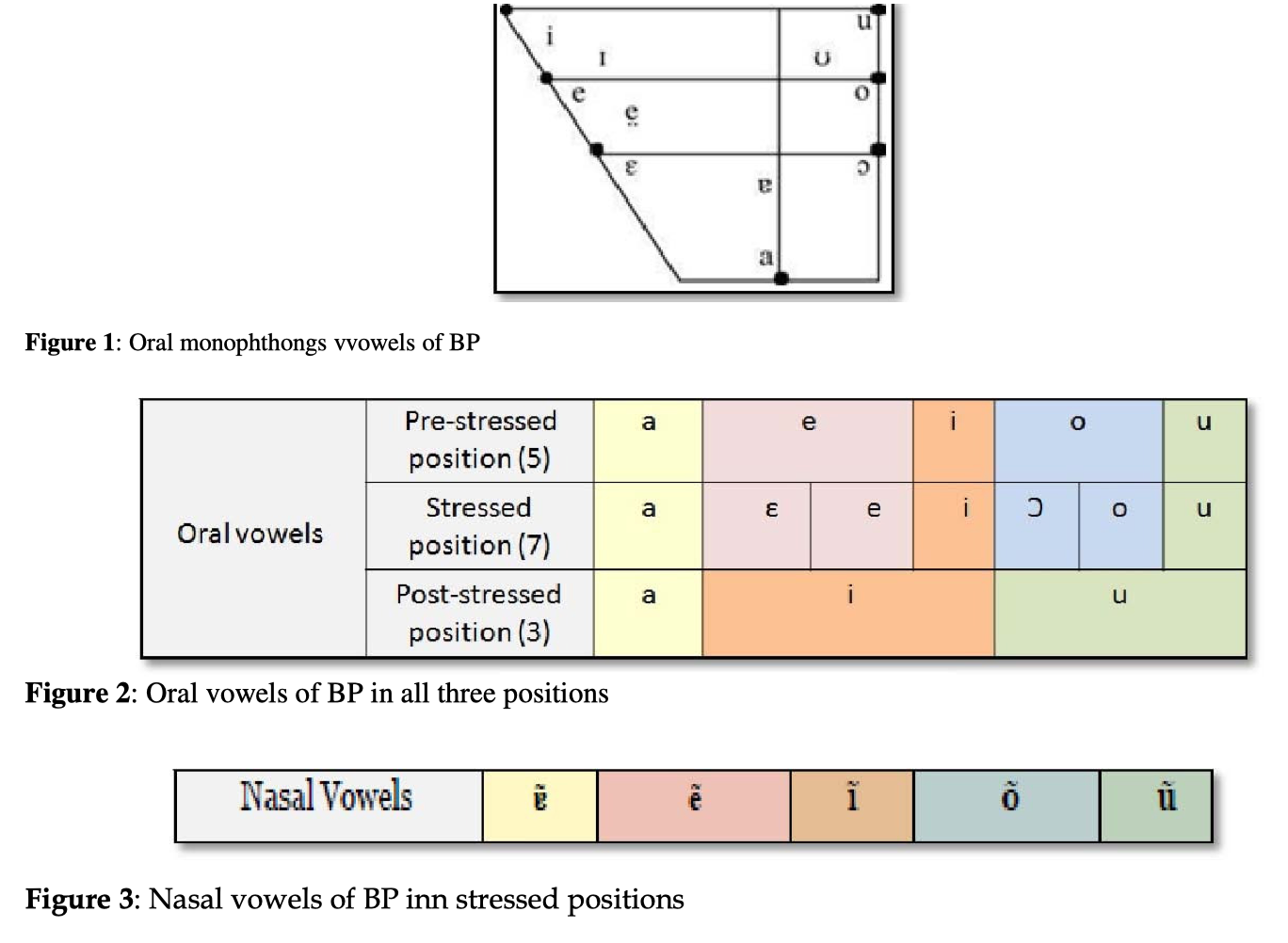
The ultrasound technique is s a non-invasive way of investigating speech so ound productions and describing them. This s study aims at characterizing, by means of ultras sound techniques and acoustic analysis, the d differences in tongue position between the centraal oral and nasal vowels in syllable stressed d position and the central vowel in stressed and unstressed positions in Brazilian Portuguuese (BP). It is also concerned with approaching g its findings with the results of BP vowel desc criptions based on cine-radiographic data (Matta MMachado, 1981), acoustic analysis (Mendes, 2003), MRI (Demolin & Medeiros, 2006; Gregioo,2006), and US (Berti, 2010; Svicero, 2012).
Methods
Speech samples from 2 female adult speakers of BP, with no speech, voice or auditory disorders, were collected. The corpora comprised eight non-sense words: /fapa/, /fapi/, /fapu/, /fipa/, /fupa/, /fãpa/, /fãpi/, /fãpu/ inserted in carrier sentences. The data were recorded at the Speech Science Research Laboratory at Queen Margaret University. A Concept M6 Digital Ultrasonic Diagnostic Imaging System, with a 120-degree transducer, was used to capture data. The ultrasound system, in conjunction with the AAA software, captured 30 frames per second. Each recording session lasted for 30 minutes. The subjects performed a reading task and repeated the sentences, which were randomly presented four times. Simultaneous recordings of the ultrasound and the audio data, using the Articulate Assistant Advanced (AAA) software, were made. The speakers wore adjustable aluminum headsets during the whole recording session. This device, which was developed at QMU, is necessary to maintain the US probe in a fixed position under the chin. At the beginning of the recording session, as part of the preparation procedure, the subjects were asked to drink water and to read some words while biting a plastic device. In this study, the palate tracings were used to describe the subjects’ articulatory movements and the Articulate Assistant Advanced software was used to annotate the spectrograms and to draw the splines of tongue contours on the ultrasound images. The AAA software produces the splines automatically and those which were not found to be well-drawn were done manually.
Analysis
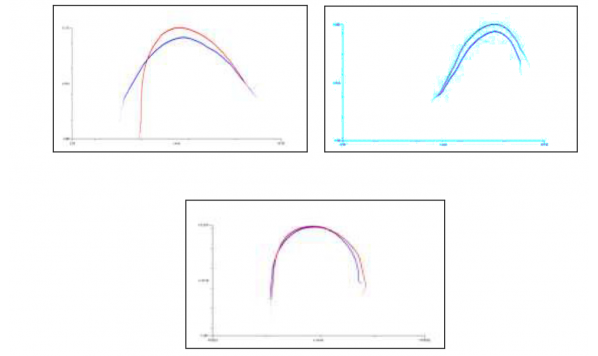
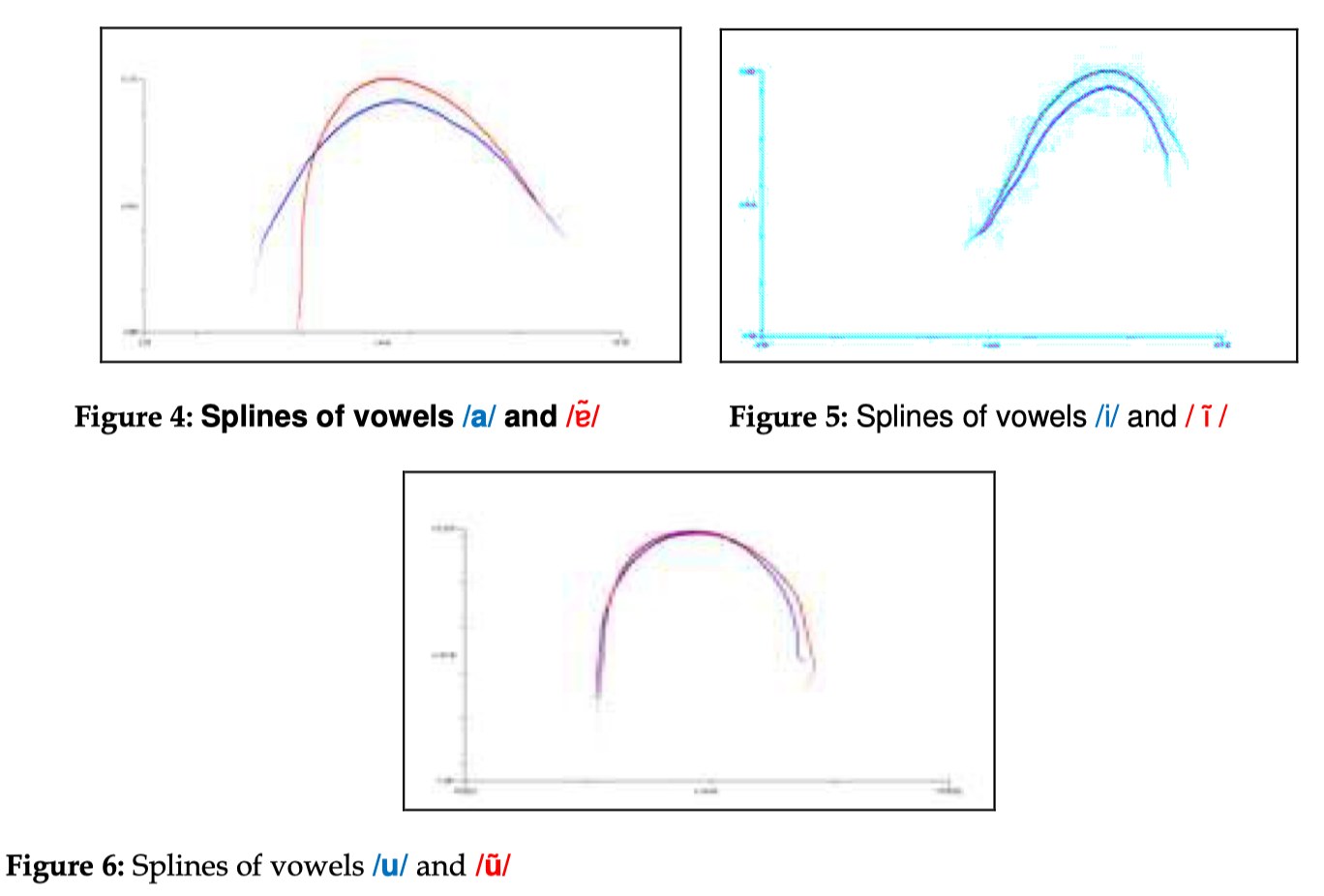
Sounds whose tongue surfaces are flat and smoothly curved (e.g. lower vowels) provide the best images. On the other hand, the less visible images come from sounds as high vowels. So, depending on the data, it could be more or less difficult to identify the tongue shape, and consequently, the precision of spline´s drawing could be prejudiced. In this specific study, we dealt with /a/ (less difficult), /u/ (intermediary difficult) and /i/ (most difficult). In this study, the palate tracings were used to describe the subjects’ articulatory movements and the Articulate Assistant Advanced software was used to annotate the spectrograms and to draw the splines of tongue contours on the ultrasound images. The AAA software produces the splines automatically and those which were not found to be well-drawn were done manually. Results of the splines and the acoustic analyses are discussed and considered in relation to the results of the other experimental (acoustic and MRI) works on BP vowels which were taken into account in this study. After that, in AAA software, we exported the data files for an excel table. There were some important values: duration (ms) of each vowel, and 42 values representing the distance (mm) from the original point for the curve for each grid of reflection.
Results
Results of the splines and the acoustic analyses are discussed and considered in relation to the results of the other experimental (acoustic and MRI) works on BP vowels which were taken into account in this study.
According to Svicero (2012), US image data revealed a better differentiation in the vertical axis the tongue body contour for BP seven oral vowels than horizontal axis. Comparing the three oral vowels, the present study had the same conclusion. In addition, for the comparison between each oral vowel with the nasal correspondent showed that both axes were relevant.
Conclusion
This US data preliminary study showed the US technique were relevant for language description and for clinical applications. Comparing to other techniques (MRI, Rx), ultrasound images may offer more advantages as being a non-invasive method. In this way, for future directions, the study will continue using hearing-impaired and/or speech disease data.
References:
BISOL,L., MAGALHÃES, J. S. Vowel reduction in Brazilian Portuguese.
http://webs2002.uab.es/filologiacatalana/papi/ABSTRACTS/Abstract69-Affil.pdf, 2002.
MACHADO, M. T. M Etude Articulatoires et acoustique des voyelles nasales du Portugais du Rio de janeiro: Analyses Radiocinematographique, sonagraphique et oscilographique. Universite des Sciences Humaines de Strasbourg. Tese de doutorado, 1981.
MENDES, B.C.A. Estudo Fonético acústico das vogais do português brasileiro. São Paulo: Pontifícia Universidade Católica de São Paulo. Tese de doutorado, 2003.
DEMOLIN, D.; MEDEIROS, B.R. Vogais nasais do português brasileiro: um estudo de IRM. Revista da ABRALIN, 2006. V.5, n.1 e 2, p. 131-42.
GREGIO, F.N. Configuração do trato vocal supraglótico na produção das vogais do Português Brasileiro: dados de imagens de ressonância magnética. São Paulo: Pontifícia Universidade Católica de São Paulo. Dissertação de mestrado, 2006.
BERTI, L.C. Investigação da produção de fala a partir da ultrassonografia do movimento de língua. In:18º Congresso Brasileiro de Fonoaudiologia: Exercício Profissional: Bases teóricas, avanço e realidade nacional. SBFa, Curitiba. 2010, v.1, p.661-1.
SVICERO, M.A.F. Caracterização Acústica e de imagens de ultrassonografia da vogais orais do Português Brasileiro. São Paulo: Pontifícia Universidade Católica de São Paulo. Dissertação de mestrado, 2012.