Many-to-one articulatory-acoustic mappings in Canadian French vowels
Many-to-one articulatory-acoustic mappings in Canadian French vowels Will Dalton and Jeff Mielke University of Ottowa We report an ultrasound investigation of two cases of many-to-one articulatory-acoustic mapping in Canadian French. The first is an allophony pattern found in high vowels, whereby non-lengthened /i y u/ in closed syllables are realized as [. / 0]. While this has traditionally been treated as a tense-lax alternation, the main acoustic feature of the lax allophones (higher F1) can be achieved either by tongue root retraction or by tongue body lowering. Our articulatory results show inter-speaker variability between the two strategies. The second case involves a change in progress in which mid front rounded vowels /ø œ œ2 / are produced with a rhotic perceptual quality, much like English ["]. Whereas previous reports (e.g., Dumas 1972, 100) have described the innovative variant as retroflex, our results show that most speakers produce it with a bunched tongue shape, and one produces it with retroflexion. Ultrasound imaging was used to produce mid-sagittal tongue video for 23 native speakers of Canadian French (including Laurentian and Acadian varieties) as they pronounced words containing / i y u ø œ œ! / in a carrier phrase, resulting in about 200 tokens of the target vowels for each participant. Smoothing-Spline ANOVA with polar coordinates was used to compare tense and lax allophones of high vowels, and to compare potentially rhotic mid front rounded vowels with non-rhotic mid front unrounded vowels. Figure 1: Tongue contours for two speakers’ [i]~[.] alternations The SSANOVA comparisons of corresponding tense and lax high vowels revealed that the speakers are evenly split between two categories: those who realize the tense-lax difference as a difference in tongue body height, and those who realize both height and tongue root advancement (Figure 1). No speakers realize the distinction with tongue root advancement alone. This has phonological implication
收录时间:2020-02-07T02:28:46Z
使用资料正文
Many-to-one articulatory-acoustic mappings in Canadian French vowels
Will Dalton and Jeff Mielke
University of Ottowa
We report an ultrasound investigation of two cases of many-to-one articulatory-acoustic mapping in Canadian French. The first is an allophony pattern found in high vowels, whereby non-lengthened /i y u/ in closed syllables are realized as [. / 0]. While this has traditionally been treated as a tense-lax alternation, the main acoustic feature of the lax allophones (higher F1) can be achieved either by tongue root retraction or by tongue body lowering. Our articulatory results show inter-speaker variability between the two strategies. The second case involves a change in progress in which mid front rounded vowels /ø œ œ2 / are produced with a rhotic perceptual quality, much like English ["]. Whereas previous reports (e.g., Dumas 1972, 100) have described the innovative variant as retroflex, our results show that most speakers produce it with a bunched tongue shape, and one produces it with retroflexion.
Ultrasound imaging was used to produce mid-sagittal tongue video for 23 native speakers of Canadian French (including Laurentian and Acadian varieties) as they pronounced words containing / i y u ø œ œ! / in a carrier phrase, resulting in about 200 tokens of the target vowels for each participant. Smoothing-Spline ANOVA with polar coordinates was used to compare tense and lax allophones of high vowels, and to compare potentially rhotic mid front rounded vowels with non-rhotic mid front unrounded vowels.
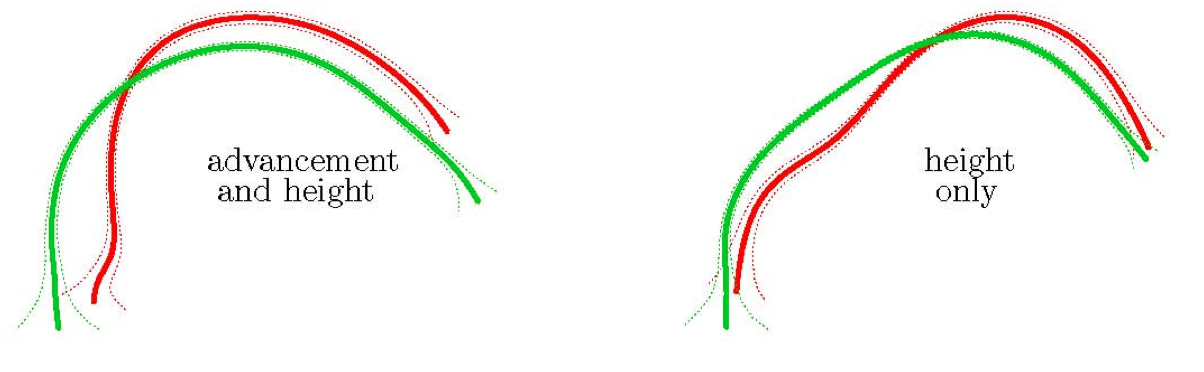
Figure 1: Tongue contours for two speakers’ [i]~[.] alternations
The SSANOVA comparisons of corresponding tense and lax high vowels revealed that the speakers are evenly split between two categories: those who realize the tense-lax difference as a difference in tongue body height, and those who realize both height and tongue root advancement (Figure 1). No speakers realize the distinction with tongue root advancement alone. This has phonological implications, considering that Canadian French also exhibits a phenomenon typically described as regressive ATR harmony (Poliquin, 2006), triggered by the lax allophones.
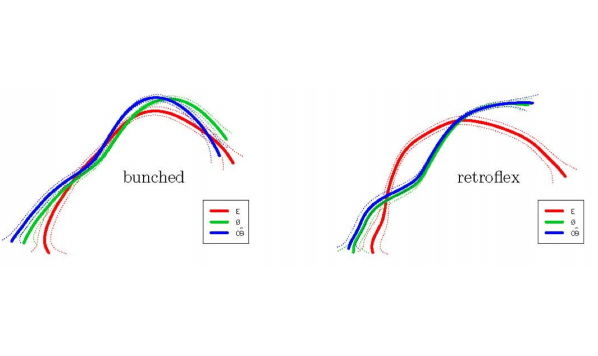
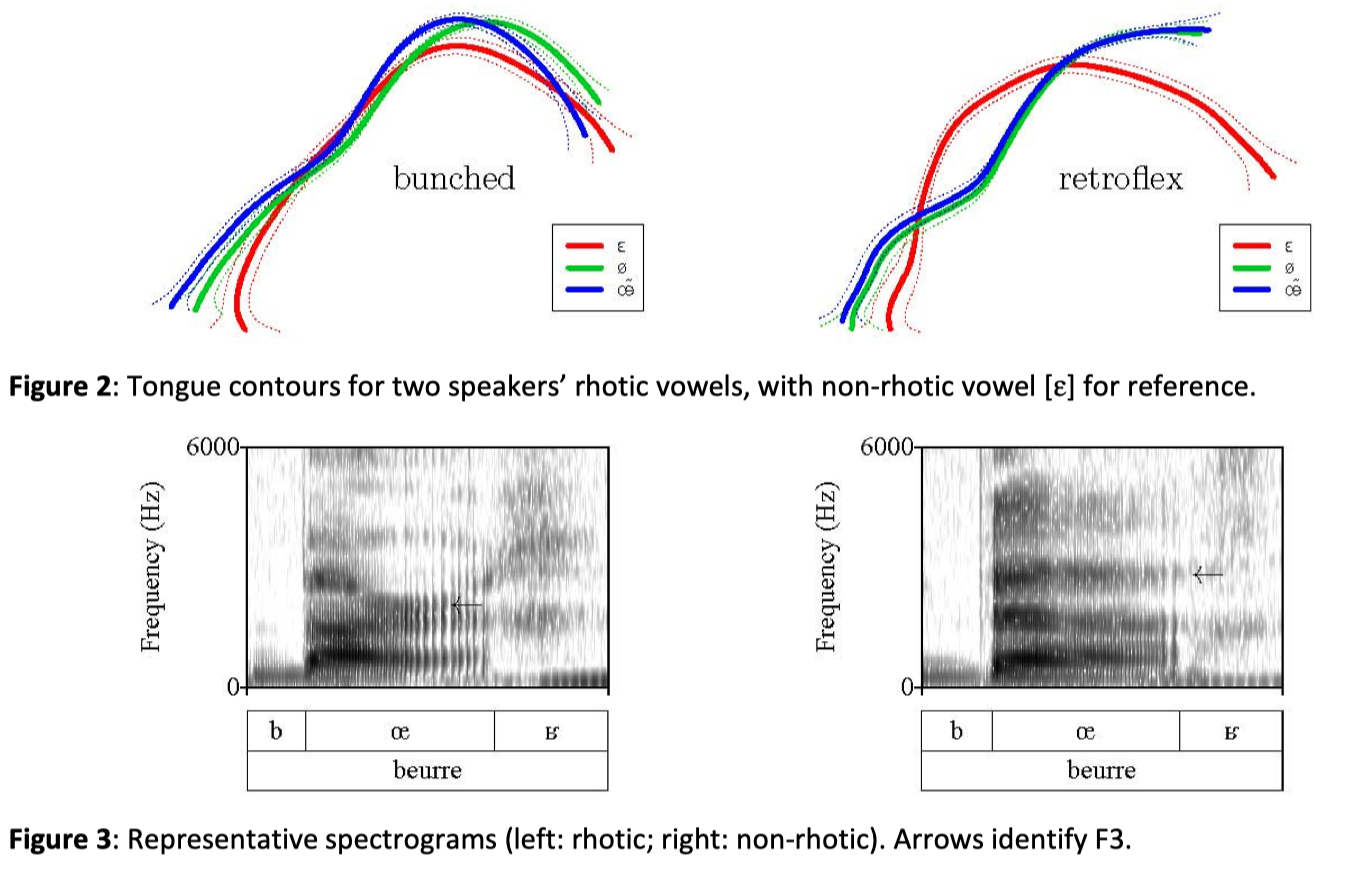
Articulatory imaging of rhotic vowels reveals that bunched tongue shapes are used to produce all moderately rhotic vowels and most extremely rhotic vowels, but that one extremely rhotic speaker uses two distinct retroflex tongue shapes to produce different rhotic vowels. Figure 2 shows examples of tongue shapes for two rhotic speakers. A corpus study of Gatineau French (Mielke, accepted) showed that the development of rhotic vowels has been gradual, and appears not to be direct result of contact with English (the change has been in progress for several decades and the vowels involved only recently became perceptually similar to English /ô/).
A further curiosity of this change in progress is that the shift from front-rounded vowel to rhotic vowel appears to involve a change in cavity affliation of the second and third formants. Zhou et al. (2008) provide evidence from MRI and acoustic modeling to show that F1, F3, F4, and F5 are all back cavity resonances for bunched and retroflex English /"/, and F2 is a resonance of the front cavity. This contrasts with front rounded vowels, where F3 is typically a front cavity resonance, and thereby more sensitive to lip rounding than the back cavity resonance F2 (e.g., Ladefoged 1996). Figure 3 shows representative spectrograms for beurre spoken by a rhotic and a non-rhotic speaker. Arrows identify F3 during the target vowel. The rhotic speaker shows lowering of F3 into F2’s range, whereas the non-rhotic speaker shows comparatively even spacing between the formants. The spectrogram for rhotic beurre also shows that the uvular /ʁ/ is still present following the rhotic vowel (which is diphthongized), and the the low F3 target is achieved before the end of the vowel.
We will show the consequences of the height/advancements trade-off for the leftward spread of laxing often referred to as Canadian French vowel harmony (which our data show is not categorical), and the relationship between the gradual advancement of vowel rhoticity and the categorical nature of bunched/retroflex variation and formant/cavity affliation.
References
Dumas, Denis. 1972. Le français populaire de Montréal: description phonologique. Université de Montréal M.A. thesis.
Ladefoged, Peter. 1996. Elements of acoustic phonetics. Chicago: University of Chicago Press.
Mielke, Jeff. accepted. Ultrasound and corpus study of a change from below: Vowel rhoticity in Canadian French. In Penn Working Papers in Linguistics 19.2: Papers from NWAV 41 .
Poliquin, Gabriel. 2006. Canadian French vowel harmony. Doctoral Dissertation, Harvard University.
Zhou, Xinhui, Carol Y. Espy-Wilson, Suzanne Boyce, Mark Tiede, Christy Holland, and Ann Choe.2008. A magnetic resonance imaging-based articulatory and acoustic study of “retroflex” and “bunched” American English /r/. Journal of the Acoustical Society of America 123:4466–4481.