Factors affecting the articulatory and acoustic characteristics of vowels in clear speech
Factors affecting the articulatory and acoustic characteristics of vowels in clear speech Jae Yung Song University of Wisconsin-Milwaukee When we speak, we are constantly modifying our speech to fit the environment and the listener. For example, when we talk to people with hearing loss, we slow down our speech and articulate individual sounds more carefully to make it easier for the listener to perceive words. This type of unique speech register is known as ‘clear speech.’ While there has been much research done on the acoustic properties of clear speech, relatively little is known about the articulatory basis of the previous acoustic findings. Furthermore, because many studies have focused on a single factor, only limited information is available on how various factors interact to affect the speaker’s production of clear speech. Thus, the purpose of this study was twofold: to examine the specific articulatory processes of clear speech for individual vowels using ultrasound, and to provide a more comprehensive investigation of the factors affecting the production of clear speech. In particular, we investigated how the type of listener (hard of hearing vs. normal hearing) and the lexical properties of words (frequency and phonological neighborhood density) interact. To address the issues, 18 monolingual speakers of American English (10 males, 8 females) participated in the experiment where they were asked to read a set of words (varying in word frequency (F) and phonological neighborhood density (D)) once to a hard of hearing listener and once to a normal hearing listener presented in video. Each speaker read 96 words in total: 2 listeners (hard of hearing vs. normal hearing) × 4 lexical properties (HighF-HighD, HighF-LowD, LowF-HighD, LowFLowD) × 2 vowels (/æ, ɑ/) × 3 words per vowel × 2 repetitions of each word. The audio was collected using a Shure KSM137 microphone, and the video of tongue movements was collected using a Sonosite 180 Plus ultrasound machine and a
收录时间:2020-02-07T02:47:43Z
使用资料正文
Factors affecting the articulatory and acoustic
characteristics of vowels in clear speech
Jae Yung Song University of Wisconsin-Milwaukee
When we speak, we are constantly modifying our speech to fit the environment and the listener. For example, when we talk to people with hearing loss, we slow down our speech and articulate individual sounds more carefully to make it easier for the listener to perceive words. This type of unique speech register is known as ‘clear speech.’ While there has been much research done on the acoustic properties of clear speech, relatively little is known about the articulatory basis of the previous acoustic findings. Furthermore, because many studies have focused on a single factor, only limited information is available on how various factors interact to affect the speaker’s production of clear speech. Thus, the purpose of this study was twofold: to examine the specific articulatory processes of clear speech for individual vowels using ultrasound, and to provide a more comprehensive investigation of the factors affecting the production of clear speech. In particular, we investigated how the type of listener (hard of hearing vs. normal hearing) and the lexical properties of words (frequency and phonological neighborhood density) interact.
To address the issues, 18 monolingual speakers of American English (10 males, 8 females) participated in the experiment where they were asked to read a set of words (varying in word frequency (F) and phonological neighborhood density (D)) once to a hard of hearing listener and once to a normal hearing listener presented in video. Each speaker read 96 words in total: 2 listeners (hard of hearing vs. normal hearing) × 4 lexical properties (HighF-HighD, HighF-LowD, LowF-HighD, LowFLowD) × 2 vowels (/æ, ɑ/) × 3 words per vowel × 2 repetitions of each word. The audio was collected using a Shure KSM137 microphone, and the video of tongue movements was collected using a Sonosite 180 Plus ultrasound machine and a C11/7-4 MHz 11-mm broadband curved array transducer.
First, we examined how two acoustic parameters, vowel duration and vowel space, vary as a function of listener type, word frequency, and neighborhood density. Three-way repeated measures of ANOVA showed that, as expected, there was the main effect of the listener type; that is, more clear speech (longer vowel duration and expanded vowel space) was directed to the listener who was hard of hearing. The main effects of word frequency and neighborhood density were also significant, with more clear speech for low frequency words and low density words. Overall, there was lack of evidence of interaction between the listener type and lexical properties of words. One exception was the listener type and density interaction effect on vowel duration; that is, speakers made extra efforts to lengthen low density words compared to high density words, in particular, for a hard of hearing listener.
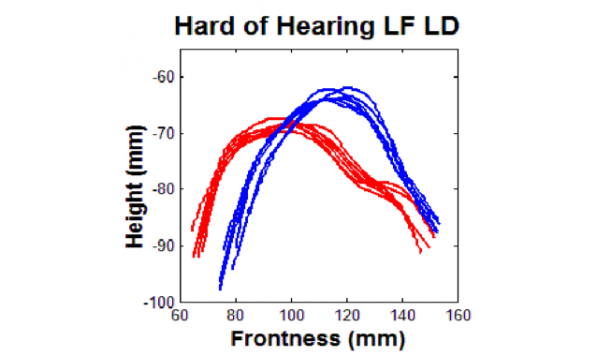
Second, we investigated the articulatory details of clear speech, focusing on four parameters quantifying the shape and position of tongue contours: asymmetry, curvature, and height and frontness of the highest point of the tongue (Aubin & Ménard, 2006; Ménard, Aubin, Thibeault, & Richard, 2012). Overall, the ultrasound data confirmed that individual vowels were more separated and less variable in clear speech (Figure 1). For the low front vowel /æ/, clarity was mainly achieved by adjusting the tongue height and curvature; that is, the tongue was lower and flatter for /æ/, exhibiting its more ‘canonical’ form in clear speech.
For the low back vowel /ɑ/, the primary parameter changed was the tongue frontness and asymmetry, with the position and mass of the tongue moving toward the back in clear speech. Taken together, our ultrasound results suggest that clear speech vowel adaptations are dynamic with both vowel-general and specific transformations.
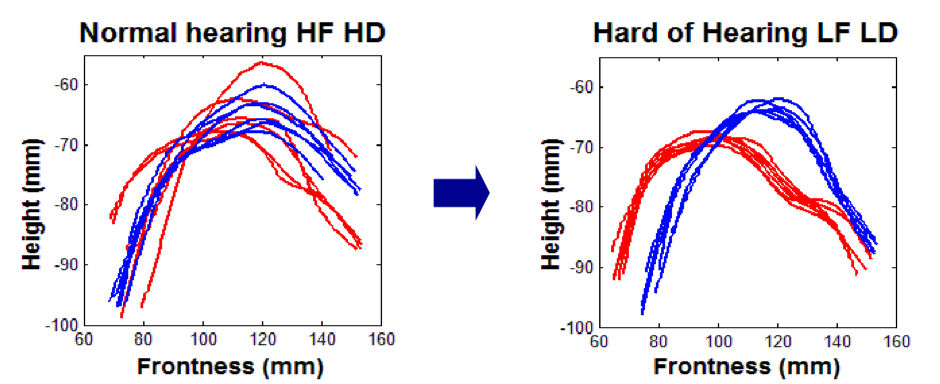
Figure 1. Representative changes in tongue contours from the condition where the participants least produced clear speech (i.e., normal hearing-HighF-HighD) to the condition where the participants most produced clear speech (i.e., hard of hearing-LowF-LowD) for the two vowels examined: /ɑ/ (red lines), /æ/ (blue lines). Individual repetitions of words from one speaker are shown on the plots.
References:
Aubin, J., & Ménard, L. (2006). Compensation for a labial perturbation: An acoustic and articulatory study of child and adult French speakers. Proceedings of the 7th International Seminar on Speech Production, Ubatuba, Brazil, 209-216.
Ménard, L., Aubin, J., Thibeault, M., & Richard, G. (2012). Comparing tongue shapes and positions with ultrasound imaging: A validation experiment using an articulatory model. Folia Phoniatrica et Logopaedica, 64, 64-72.