A single speaker study of Modern Greek:The effect of stress, syllable position and consonantal context on vowels, and of vowel context on intervocalic consonants
A single speaker study of Modern Greek:The effect of stress, syllable position and consonantal context on vowels, and of vowel context on intervocalic consonants James M Scobbie1 and Anna Sfakianaki2 1QMU & 2Aristotle University of Thessaloniki Introduction Modern Greek has a typical five-vowel system, /i, e, a, o, u/. Several studies, mainly acoustic, have examined the effect of stress and consonantal context on vowel quality. However, there is no consensus regarding the influence of these parameters on vowel quality, as some of the studies report minimal differences between stressed and unstressed vowels (e.g., Dauer, 1980; Arvaniti, 1994, 2000), whereas others document significant effects on vowel height and backness due to stress (e.g., Fourakis et al., 1999; Nicolaidis & Rispoli, 2005; Baltazani, 2007; Nicolaidis & Sfakianaki, 2007). Vowel sensitivity to consonantal effects has been found minimal along the F1 axis (tongue height) and more substantial along the F2 axis (tongue anteriority) in previous studies of coarticulation (i.e., EPG: Nicolaidis, 1997; acoustic: Sfakianaki, 2012). This pilot study uses ultrasound tongue imaging (UTI) to investigate these topics from an articulatory perspective. The speaker is the 2nd author. We are aware of just one other UTI study on Greek, which studies the relative timing of consonants in clusters (Yip, 2012). Protocol Three blocks of stimuli were recorded from one Greek female adult. Each item was repeated six times, and 216 tokens were analysed in Articulate Assistant Advanced (Articulate Instruments, 2012). Tongue data was recorded at 100fps at QMU with the high-speed Ultrasonix system, using AAA. Synchronised acoustics were captured, with a video image of the lips (de-interlaced to 60fps). The speaker wore a headset (Articulate Instruments 2008). Data has been rotated to the occlusal plane using a bite plate (Lawson et al 2013). Materials Single pseudowords with no carrier as follows, to avoid coarticulatory effects w
收录时间:2020-02-07T03:43:54Z
使用资料正文
A single speaker study of Modern Greek:The effect of stress, syllable position and consonantal context on vowels, and of vowel context on intervocalic consonants
James M Scobbie1 and Anna Sfakianaki2
1QMU & 2Aristotle University of Thessaloniki
Introduction
Modern Greek has a typical five-vowel system, /i, e, a, o, u/. Several studies, mainly acoustic, have examined the effect of stress and consonantal context on vowel quality. However, there is no consensus regarding the influence of these parameters on vowel quality, as some of the studies report minimal differences between stressed and unstressed vowels (e.g., Dauer, 1980; Arvaniti, 1994, 2000), whereas others document significant effects on vowel height and backness due to stress (e.g., Fourakis et al., 1999; Nicolaidis & Rispoli, 2005; Baltazani, 2007; Nicolaidis & Sfakianaki, 2007). Vowel sensitivity to consonantal effects has been found minimal along the F1 axis (tongue height) and more substantial along the F2 axis (tongue anteriority) in previous studies of coarticulation (i.e., EPG: Nicolaidis, 1997; acoustic: Sfakianaki, 2012).
This pilot study uses ultrasound tongue imaging (UTI) to investigate these topics from an articulatory perspective. The speaker is the 2nd author. We are aware of just one other UTI study on Greek, which studies the relative timing of consonants in clusters (Yip, 2012).
Protocol
Three blocks of stimuli were recorded from one Greek female adult. Each item was repeated six times, and 216 tokens were analysed in Articulate Assistant Advanced (Articulate Instruments, 2012). Tongue data was recorded at 100fps at QMU with the high-speed Ultrasonix system, using AAA. Synchronised acoustics were captured, with a video image of the lips (de-interlaced to 60fps). The speaker wore a headset (Articulate Instruments 2008). Data has been rotated to the occlusal plane using a bite plate (Lawson et al 2013).
Materials
Single pseudowords with no carrier as follows, to avoid coarticulatory effects with adjacent words or from lingual consonants, and to maximize target segment distinctiveness.
a. the five vowels /i, e, a, o, u/ sustained in isolation
b. the five vowels in word-like disyllables of the form /ˈpVpV/ or /pVˈpV/
c. the three corner vowels /i, a, u/ in disyllables of the form /3VCV/, C= /t, s, n, k, x, l, r/.
Results
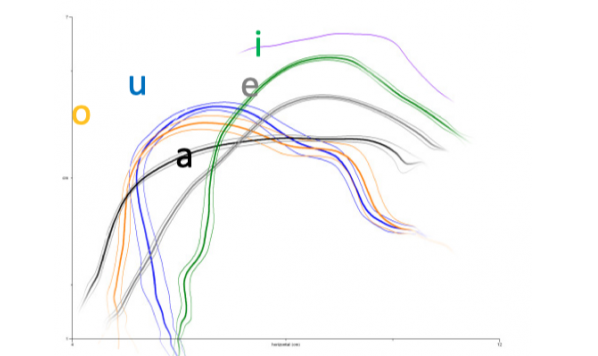
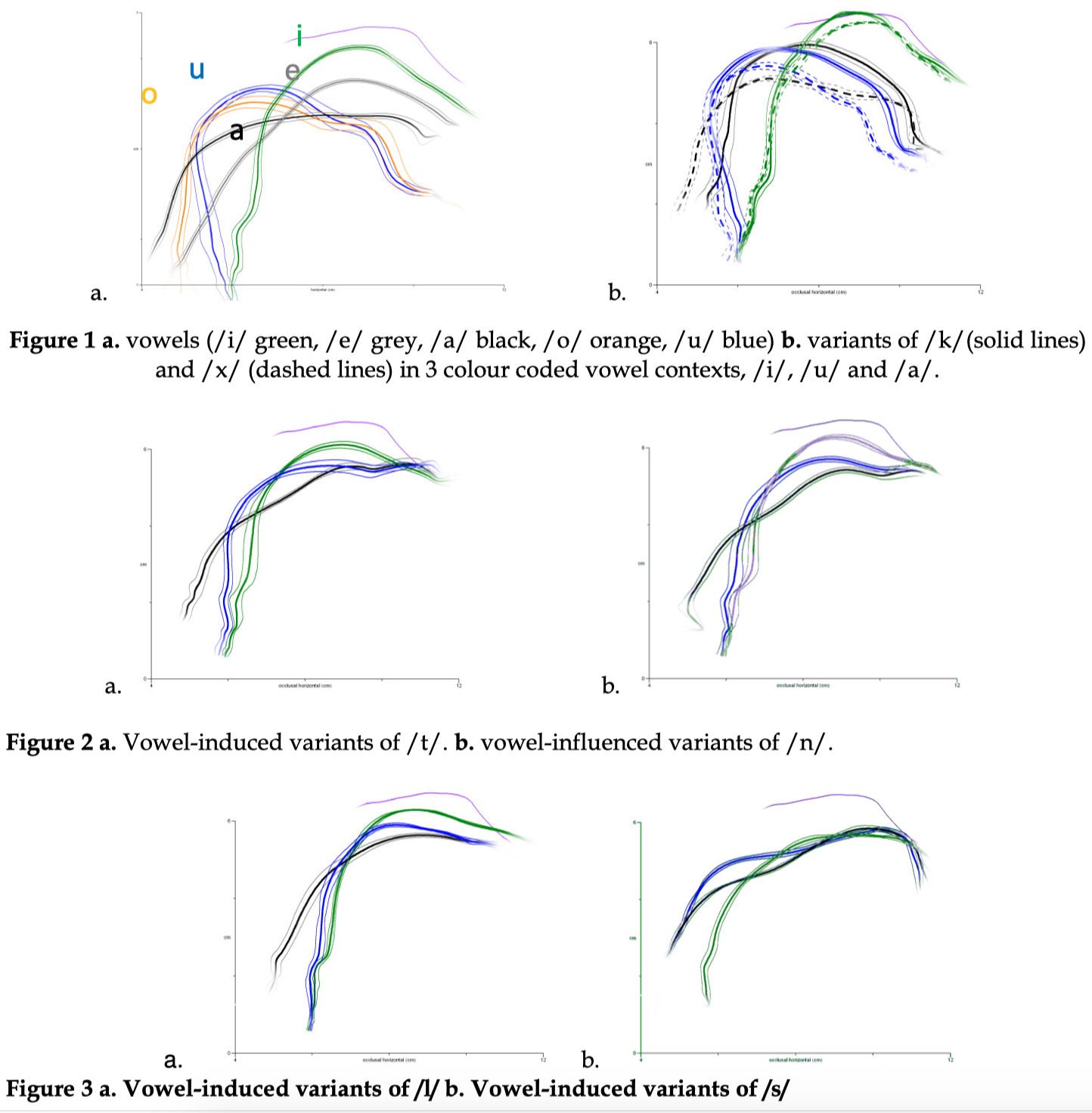
Stress and position of the vowel in the disyllable (word-initial vs. word-final) do not seem to play an independent or combined effect on the overall tongue shape, which is highly consistent. For example, the first /a/ and the second /a/ in /3papa/ are highly similar in terms of tongue contour. There were however differences between the vowels in the pVpV pseudowords vs. the sustained vowels in isolation. See Figure 1a for average vowel shapes, each mean tongue shape flanked by 1 s.d.
In 3VCV, consonantal effects seem to be stronger on the second, weak, vowel than on the first, stressed one, suggesting a higher degree of coarticulation between the consonant and the word-final unstressed vowel. Greater C-to-V effects on unstressed vs. stressed vowels were seen in a previous acoustic study of coarticulation in Greek disyllables, in which higher coarticulatory magnitude was reported in the carryover direction (Sfakianaki, 2012). This finding may reflect the preferred V.CV rather than VC.V syllable pattern for Greek in this context (Joseph & Philippaki-Warburton, 1987).
The consonants in VCV contexts also show some interesting features. Figure 1b shows the the palatal pair of allophones of /k/ and /x/ related by a simple relative constrictional weakening, while the stop/fricative distinction in the back allophones differ greatly in place of articulation: /x/ is uvular in /uxu/ and almost pharyngeal in /axa/. Figures 2a and 2b. show obvious palatalisation of /t/ and /n/ respectively in /i_i/. The also show pharyngealisation in /a_a/. Both consonants pattern with fronted tongue root for /i/ and /u/. The lateral /l/ (Figure 2a) is also like /n/ and /t/. Figure 3b on the other hand shows a tip-down /s/ with different coarticulatory patterns. There is more coarticulatory resistence for /s/ than /t/ and /n/ (as might be expected) in the anterior tongue region (Zharkova, Hewlett and Hardcastle, 2012). While the differences in the tongue root are just as large as the other coronal consonants, surprisingly they are different in organisation: /usu/ patterns with /asa/ this time, in having root retraction, rather than advancement like /isi/.
We do not know the extent to which these articulatory patterns are idiolectal or typical of Modern Greek, nor have we presented the acoustics of this speaker. However, the patterns shown are highly consistent, with low token-to-token variation, and reflect results from previous acoustic studies that show little acoustic variation due to stress or word position.
References
Articulate Instruments (2008) Ultrasound Stabilisation Headset Users Manual: Revision 1.4. Edinburgh:Articulate Instruments Ltd.
Articulate Instruments (2012) Articulate Assistant Advanced User Guide: Version 2.14. Edinburgh:Articulate Instruments Ltd.
Arvaniti, A. (1994). Acoustic features of Greek rhythmic structure. Journal of Phonetics, 22, 239-268.
Arvaniti, A. (2000). The phonetics of stress in Greek. Journal of Greek Linguistics, 1, 9-38.
Baltazani, M. (2007). Prosodic rhythm and the status of vowel reduction in Greek. Selected Papers on Theoretical and Applied Linguistics from the 17 th International Symposium on Theoretical and Applied Linguistics, 1, 31-43. Department of Theoretical & Applied Linguistics, Aristotle University of Thessaloniki.
Dauer, R. M. (1980). Stress and rhythm in Modern Greek. Doctoral Dissertation. University of Edinburgh, Edinburgh, UK.
Fourakis, M., Botinis, A. & Katsaiti, M. (1999). Acoustic characteristics of Greek vowels. Phonetica 56, 2843.
Joseph, B. & Philippaki-Warborton, I. (1987). Modern Greek. Kent: Croom Helm Ltd.
Lawson, E. & Scobbie, J.M. (2013) Bite plate: a tool for standardising probe orientation to improve UTI interpretation. Poster presented at Ultrafest6, Edinburgh.
Nicolaidis, K. (1997). Sources of articulatory variability in Greek: an electropalatographic study. Doctoral Dissertation. University of Reading, Reading, UK.
Nicolaidis, K. & Rispoli, R. (2005). The effect of noise on speech production: An acoustic study. Studies in Greek Linguistics, 25, 415-426.
Nicolaidis, K. & Sfakianaki, A. (2007). An acoustic analysis of vowels produced by Greek speakers with hearing impairment. Proceedings of the 16 th International Congress of Phonetic Sciences, ID 1358, 1969-1972. Saarbrücken.
Sfakianaki, A. (2012). An acoustic study of coarticulation in the speech of Greek adults with normal hearing and hearing impairment. Unpublished Doctoral Thesis. Aristotle University of Thessaloniki.
Yip, J. (2012) Linguistic Effects on the Timing of Gestural Coordination in Modern Greek CC Sequences.Poster, 164th Meeting of the Acoustical Society of America. Kansas City, MO: 22–26 October 2012.
Zharkova, N., Hewlett, N. & Hardcastle, W. J. (2012). An ultrasound study of lingual coarticulation in /sV/ syllables produced by adults and typically developing children. Journal of the International Phonetic Association, 42, 193-208.