An Edinburgh Speech Production Facility
An Edinburgh Speech Production Facility The EPSRC‐funded Edinburgh Speech Production Facility is designed for the collection of synchronized articulatory and acoustic data during dialogue. It will be open to the international research community for funded use as of September 2010. As part of the EPSRC project, we recorded a corpus of dialogue sessions (8 are planned, 6 are recorded to date). The transcribed corpus will be available in 2010. We briefly describe the facility setup, and our recorded corpus. 1. The facility The facility is built around two Carstens’ AG500 electromagnetic articulographs (EMA). Synchronization of both EMA data sources and the acoustic waveforms is achieved by capturing (a) synch impulses of both machines and (b) the acoustic waveforms of both speakers by means of Articulate Instruments’ Ltd hardware. This hardware includes an ADLINK DAQ‐2213 8‐channel, 16‐bit differential input data acquisition card mounted to a standard PC and connected to an 8+4 Channel Analogue/Video Breakout Box. The hardware is also capable of synchronizing other time series data (EPG). Specific problems of the dual setup include a) electromagnetic inter‐machine interference b) issues of temporal synchronization, c) the necessity of a talkback system, d) position estimation problems arising from e.g. larger amounts of head movement in dialogue as compared to monologue settings, and e) issues of position estimation arising from long trial durations. We will discuss these in a fuller presentation. Position‐estimation procedures include those described in Hoole & Zierdt (2006) and unscented Kalman filtering‐based algorithms, developed by K. Richmond. Data analysis software (Articulate Assistant Advanced, EMA module) has been commissioned from Articulate Instruments Ltd (2009). 2. The dialogue corpus The articulatory corpus was designed with two main intersecting aims. The first was to elicit a range of speech styles or registers from the speakers, common in language use
收录时间:2020-02-05T05:38:43Z
使用资料正文
An Edinburgh Speech Production Facility
The EPSRC‐funded Edinburgh Speech Production Facility is designed for the collection of synchronized articulatory and acoustic data during dialogue. It will be open to the international research community for funded use as of September 2010. As part of the EPSRC project, we recorded a corpus of dialogue sessions (8 are planned, 6 are recorded to date). The transcribed corpus will be available in 2010. We briefly describe the facility setup, and our recorded corpus.
1. The facility
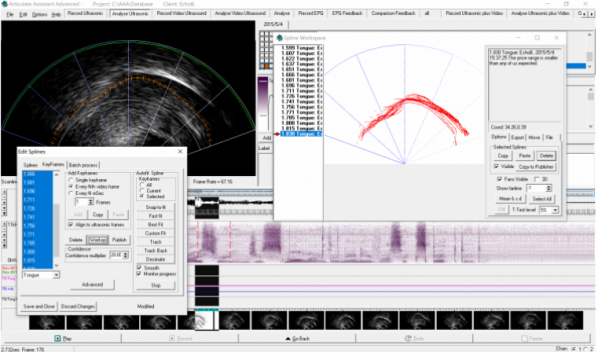
The facility is built around two Carstens’ AG500 electromagnetic articulographs (EMA). Synchronization of both EMA data sources and the acoustic waveforms is achieved by capturing (a) synch impulses of both machines and (b) the acoustic waveforms of both speakers by means of Articulate Instruments’ Ltd hardware. This hardware includes an ADLINK DAQ‐2213 8‐channel, 16‐bit differential input data acquisition card mounted to a standard PC and connected to an 8+4 Channel Analogue/Video Breakout Box. The hardware is also capable of synchronizing other time series data (EPG). Specific problems of the dual setup include a) electromagnetic inter‐machine interference b) issues of temporal synchronization, c) the necessity of a talkback system, d) position estimation problems arising from e.g. larger amounts of head movement in dialogue as compared to monologue settings, and e) issues of position estimation arising from long trial durations. We will discuss these in a fuller presentation. Position‐estimation procedures include those described in Hoole & Zierdt (2006) and unscented Kalman filtering‐based algorithms, developed by K. Richmond. Data analysis software (Articulate Assistant Advanced, EMA module) has been commissioned from Articulate Instruments Ltd (2009).
2. The dialogue corpus
The articulatory corpus was designed with two main intersecting aims. The first was to elicit a range of speech styles or registers from the speakers, common in language use. The corpus includes several types of spontaneous speech and therefore provides an alternative to traditional reading corpora. The second was to extend the corpus beyond single‐speaker monologue, by using tasks that promote natural discourse and interaction. A subsidiary driver was to use speakers from a wider dialect variety than is normally used. To this end, we recorded primarily Scottish English and Southern British English participants in dialogue with each other. Spontaneous dialogue was supplemented by other tasks, some undertaken in a preliminary acoustics‐only screening session which included a modified and extended Lexical set sample (Wells 1982) and a revised version of Comma Gets a Cure (McCullough & Somerville 2000). The articulatory data collection protocol includes a variety of tasks:
• Story reading (Comma Gets a Cure), lexical sets, spontaneous story telling, diadochokinetic tasks (monologue)
• Map tasks (Anderson et al. 1991), Spot the Difference picture tasks (Bradlow et al. 2007), story‐recall (dialogue)
• Shadowing
Each dialogue session includes approximately 30 minutes of speech. We will exemplify the key characteristics of the corpus, presenting an articulatory perspective on the following phenomena: naturally occurring covert speech errors, accent accommodation, turn taking, and shadowing.
The corpus includes several types of annotations: 1) an orthographic transcription, 2) disfluencies, and 3) a modified ToBI transcription (for part of the corpus only). Further details and examples will be provided in the full presentation.
References
Anderson, A., Bader, M., Bard, E., Boyle, E., Doherty, G. M., Garrod, S., Isard, S., Kowtko, J., McAllister, J., Miller, J., Sotillo, C., Thompson, H. S. & Weinert, R. (1991). The HCRC Map Task Corpus. Language and Speech, 34, pp. 351-366.
Articulate Instruments Ltd (2009) Articulate Assistant Advanced: Version 2.09. Edinburgh, UK: Articulate Instruments Ltd.
Bradlow, A.R., Baker, R.E., Choi,A., Kim, M. & van Engen, K.J. (2007). The Wildcat corpus of native- and foreign-accented English. Journal of the Acoustical Society of America, 121(5) Pt. 2, 3072.
Carstens Medizinelektronik http://www.articulograph.de/
Hoole, P & Zierdt, A. (2006). Five-dimensional articulography. in Stem-, Spraak- en Taalpathologie, Supplement June 2006, (invited paper 5th Int. Conf. Speech Motor Control Nijmegen), Nijmegen, 2006, vol. 14, p. 57.
McCullough, J. & Somerville, B (2000). Comma Gets a Cure. Edited by D. Honorof. http://web.ku.edu/~idea/readings/comma.htm
Wells, J.C. (1982). Accents of English I: An Introduction. Cambridge University Press.