Morphological effects on the darkness of English intervocalic /l/
Morphological effects on the darkness of English intervocalic /l/ Sang-Im Lee Kim and Lisa Davidson New York University Articulatory and acoustic studies have provided evidence that in word-initial and word-final positions, English /l/ exhibits substantial differences in ‘darkness’: darker [ɫ] in word-final position is produced with a more retracted tongue dorsum and lowered tongue body than lighter [l] in word-initial position. The darkness of intervocalic /l/, however, is variable. Using articulatory and acoustic evidence, Sproat and Fujimura (1993) argue that /l/ darkness is on a continuum affected by duration and boundary strength. Hayes (2000) claims that the morphological status of intervocalic /l/s should affect whether they are produced as light or dark variants. He distinguishes between two types of intervocalic /l/s which would be syllabified as an onset by most phonological theories: those where the /l/ is the final consonant of a related monomorpheme and found before a morpheme boundary (feel#ing), and those where /l/ is part of the suffix after the boundary (free#ly). Unlike Sproat and Fujimura, Hayes argues that there are discrete light and dark allophones of /l/, and that dark [ɫ] should be produced more often when it is before the morpheme boundary and that light [l] should be found more frequently after the boundary. In this study, ultrasound imaging is used to investigate whether the morphological affiliation of the /l/ affects the darkness of /l/. Departing from Hayes (2000), we predict that complex morphological and phonological factors give rise to gradient darkness for the following three types of stimuli: (1) post-boundary: when /l/ corresponds with the onset of a suffix (e.g. flaw#less, coup#less), (2) pre-boundary: when /l/ corresponds with the final position of the stem word (e.g. tall#est, cool#est), and (3) stem: when /l/ is the final consonant of a stem word (e.g. tall, cool). In particular, pre-boundary /l/ is predicted to be darker tha
收录时间:2020-02-06T03:02:46Z
使用资料正文
Morphological effects on the darkness of English intervocalic /l/
Sang-Im Lee Kim and Lisa Davidson
New York University
Articulatory and acoustic studies have provided evidence that in word-initial and word-final positions, English /l/ exhibits substantial differences in ‘darkness’: darker [ɫ] in word-final position is produced with a more retracted tongue dorsum and lowered tongue body than lighter [l] in word-initial position. The darkness of intervocalic /l/, however, is variable. Using articulatory and acoustic evidence, Sproat and Fujimura (1993) argue that /l/ darkness is on a continuum affected by duration and boundary strength. Hayes (2000) claims that the morphological status of intervocalic /l/s should affect whether they are produced as light or dark variants. He distinguishes between two types of intervocalic /l/s which would be syllabified as an onset by most phonological theories: those where the /l/ is the final consonant of a related monomorpheme and found before a morpheme boundary (feel#ing), and those where /l/ is part of the suffix after the boundary (free#ly). Unlike Sproat and Fujimura, Hayes argues that there are discrete light and dark allophones of /l/, and that dark [ɫ] should be produced more often when it is before the morpheme boundary and that light [l] should be found more frequently after the boundary. In this study, ultrasound imaging is used to investigate whether the morphological affiliation of the /l/ affects the darkness of /l/.
Departing from Hayes (2000), we predict that complex morphological and phonological factors give rise to gradient darkness for the following three types of stimuli: (1) post-boundary: when /l/ corresponds with the onset of a suffix (e.g. flaw#less, coup#less), (2) pre-boundary: when /l/ corresponds with the final position of the stem word (e.g. tall#est, cool#est), and (3) stem: when /l/ is the final consonant of a stem word (e.g. tall, cool). In particular, pre-boundary /l/ is predicted to be darker than the post-boundary /l/ due to the potential paradigmatic relation with the coda /l/ in the stem form, whereas it is predicted to be lighter than the stem /l/ due to possible phonological pressure for there to be an onset for the following vowel-initial suffix. In the ultrasound imaging, six American English speakers produced these three types of stimuli in various vowel contexts. The words were embedded in short phrases (e.g. ‘the tallest building’, ‘the coupless revolution’), randomized, and repeated 10 times.
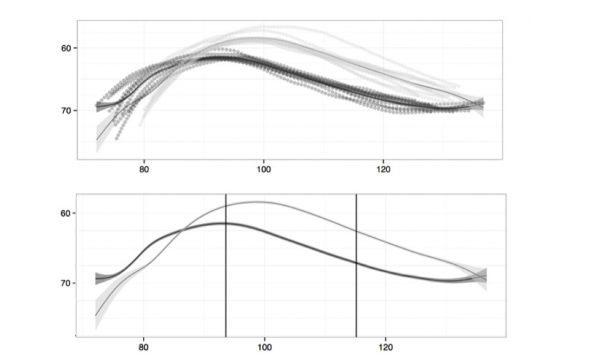
To compare the degree of retraction among the three different types of /l/, the frame corresponding to the most retracted position of the tongue dorsum during the production of the /l/ was selected. The articulation of /l/ was compared using a smoothing spline ANOVA (SS ANOVA, Davidson 2006, Wahba 1990). In Figure 1, comparing the most retracted frame of the /l/s in coupless (in grey) and coolest (in dark), the top figure represent each repetition for one speaker and the bottom are the splines which indicate the best fit to the data. The tongue curves were divided into thirds where the leftmost portion roughly corresponds to the tongue dorsum (TD) and the middle portion corresponds to the tongue body (TB). In this particular case, the pre-boundary /l/ (coolest) was coded as more retracted for TD and lowered for TB than the post-boundary /l/ (coupless). For the acoustic analysis, F1 and F2 were measured where the maximal retraction frame was captured, and normalized intensity was also calcuated.
The results showed that the predicted order was upheld for both articulatory and acoustic measures. For most cases, either tongue dorsum retraction or tongue body lowering indicated greatest darkness for the stem /l/ and intermediate for the pre-boundary /l/, followed by the post-boundary condition. Likewise, F1, normalized intensity, and to a lesser extent F2 measures were also consistent with the articulatory results. The results are consistent with Hayes (2000) in that speakers produce a darker /l/ for the pre-boundary /l/ to maintain the paradigmatic relationship with the stem /l/. However, the results crucially refute the assumption of a strict bimodal allophonic production for /l/. Rather, the presence of the intermediate implementation for the pre-boundary /l/ is compatible with /l/ in the phonetic continuum proposed by Sproat and Fujimura (1993). We also discuss a challenge that our data presents for most current formal phonological theories where generating gradient forms is not trivial.
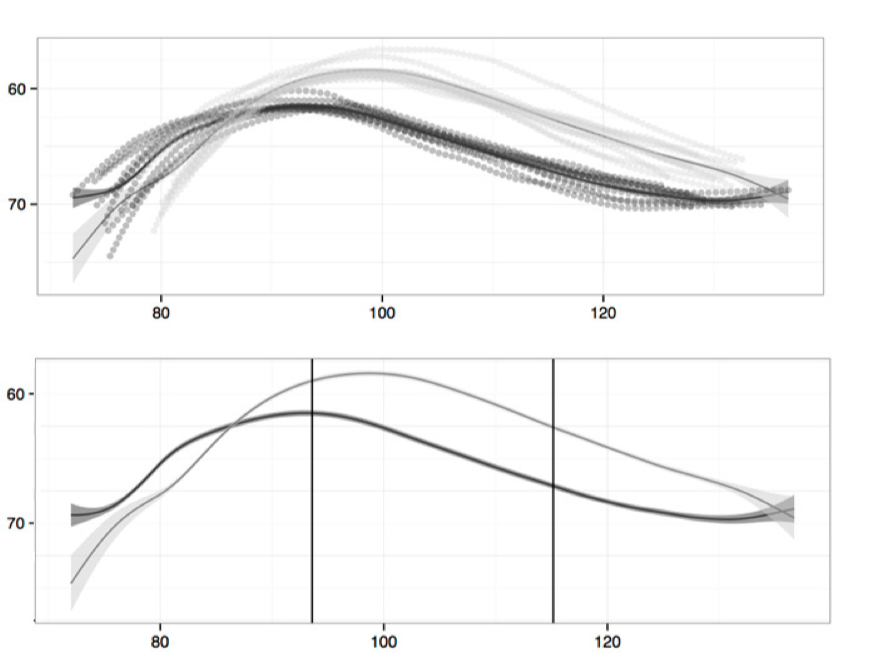
Figure 1. Top. Raw data points from ten repetitions (dotted lines) for comparison of the tongue shape for /l/ in coolest (in black) vs. coupless (in grey) for subject AD. Bottom. Smoothing spline estimate and 95% Bayesian confidence interval for comparison of the mean curves. The vertical lines are a rough division of the vocal tract into tongue dorsum (left), tongue body (middle), and tongue tip/blade (front). The tongue tip is on the right and the tongue dorsum is on the left.
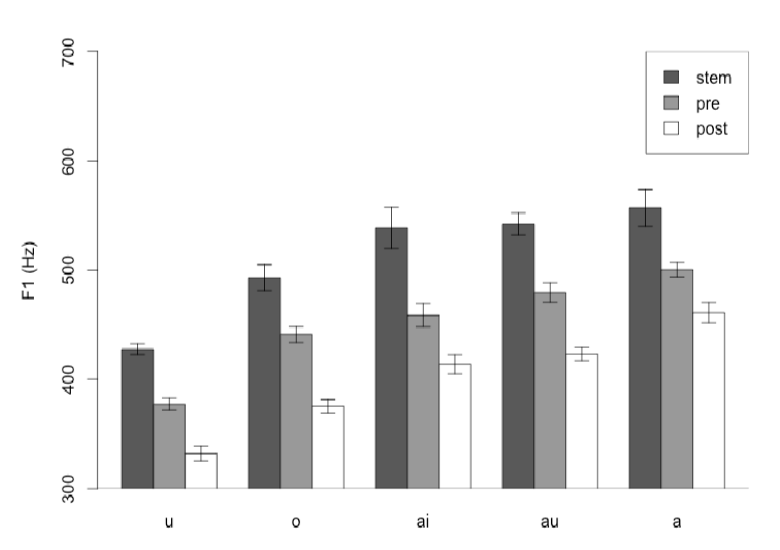
Figure 2. Mean of F1 (Hz) at minimum F2. Error bars indicate standard error.
References
Davidson, Lisa. 2006. Comparing tongue shapes from ultrasound imaging using smoothing spline analysis of variance. Journal of the Acoustical Society of America 120 (1), 407-415.
Hayes, Bruce. 2000. Gradient well-formedness in Optimality Theory. In Joost Dekkers, Frank van der Leeuw and Jeroen van de Weijer, Eds., Optimality Theory: Phonology, Syntax, and Acquisition. Oxford: Oxford University Press, pp. 88-120.
Sproat, R. and Osamu Fujimura. 1993. Allophonic variation in English /l/ and its implications for phonetic implementation. Journal of Phonetics 21, 291-311.
Wahba, Grace. 1990. Spline Models for Observational Data. Philadephia: Society of Industrial and Applied Mathematics.