An ultrasound study of retroflex and alveolar laterals in Kannada
An ultrasound study of retroflex and alveolar laterals in Kannada Alexei Kochetov, N. Sreedevi, Midula Kasim and R. Manjula Department of Linguistics, University of Toronto Retroflex consonants in Dravidian languages are known to be produced with the underside of the tongue making a constriction behind the alveolar ridge (Ladefoged & Bhaskararao, 1983). The retraction and raising of the tongue blade is accompanied by some hollowing of the anterior tongue body, resulting in the characteristic concave tongue shape. Less is known, however, about the shape and the relative position of the posterior tongue body/root during the retroflex production. In a recent ultrasound study of Malayalam liquids, Scobbie et al. (in press) found that the retroflex lateral /ɭ/ was produced with a substantial retraction of the tongue root (pharyngealization), relative to alveolar /l/ and the preceding vowel /a/. An MRI study of Tamil liquids by Narayanan et al. (1999), however, revealed a wider pharyngeal cavity for /ɭ/ than /l/, indicative of some tongue root/body advancement for the former. Similar evidence for the retroflex tongue body advancement was found in an ultrasound study of Kannada stops by Kochetov et al. (2012), where the posterior tongue body for /ʈ/ was more front relative to the rest position and /t/, yet similar to that for /ʧ/. The partly contradictory results of these studies could be due to language-specific differences in the production of retroflexes, or due to articulatory differences between stops and laterals. To address the issue, this paper presents results of an ultrasound study of laterals /ɭ/ and /l/ produced by 10 native speakers of Kannada (5 females and 5 males) from Mysore, Karnataka (South India). The materials included the words /haɭɭa/ ‘small stream’, /alla/ ‘not’, and /aʈʈa/ ‘garret’ (as a control), among other items. Ten repetitions of each word were collected using a PI 7.5 MHz SeeMore probe (Interson Corporation) connected via USB to a laptop comp
收录时间:2020-02-06T03:23:57Z
使用资料正文
An ultrasound study of retroflex and alveolar laterals in Kannada
Alexei Kochetov,
N. Sreedevi, Midula Kasim and R. Manjula
Department of Linguistics, University of Toronto
Retroflex consonants in Dravidian languages are known to be produced with the underside of the tongue making a constriction behind the alveolar ridge (Ladefoged & Bhaskararao, 1983). The retraction and raising of the tongue blade is accompanied by some hollowing of the anterior tongue body, resulting in the characteristic concave tongue shape. Less is known, however, about the shape and the relative position of the posterior tongue body/root during the retroflex production. In a recent ultrasound study of Malayalam liquids, Scobbie et al. (in press) found that the retroflex lateral /ɭ/ was produced with a substantial retraction of the tongue root (pharyngealization), relative to alveolar /l/ and the preceding vowel /a/. An MRI study of Tamil liquids by Narayanan et al. (1999), however, revealed a wider pharyngeal cavity for /ɭ/ than /l/, indicative of some tongue root/body advancement for the former. Similar evidence for the retroflex tongue body advancement was found in an ultrasound study of Kannada stops by Kochetov et al. (2012), where the posterior tongue body for /ʈ/ was more front relative to the rest position and /t/, yet similar to that for /ʧ/. The partly contradictory results of these studies could be due to language-specific differences in the production of retroflexes, or due to articulatory differences between stops and laterals.
To address the issue, this paper presents results of an ultrasound study of laterals /ɭ/ and /l/ produced by 10 native speakers of Kannada (5 females and 5 males) from Mysore, Karnataka (South India). The materials included the words /haɭɭa/ ‘small stream’, /alla/ ‘not’, and /aʈʈa/ ‘garret’ (as a control), among other items. Ten repetitions of each word were collected using a PI 7.5 MHz SeeMore probe (Interson Corporation) connected via USB to a laptop computer. The participants wore an Articulate Instruments stabilizing headset. Tongue contours during the consonant closure were traced using EdgeTrak (Li et al., 2005). To evaluate differences in the tongue body position and shape between pairs of consonants, a series of Smoothing Spline ANOVAs (SS-ANOVA; Davidson, 2006) was performed, separately for each speaker and across the speakers. Analysis of the simultaneously collected acoustic data involved measurements of formants F1-F4 during, before, and after the lateral closure.
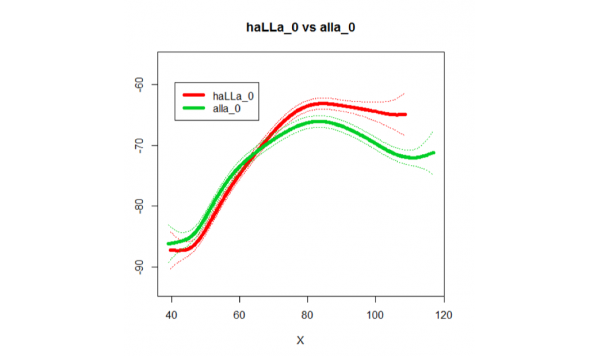
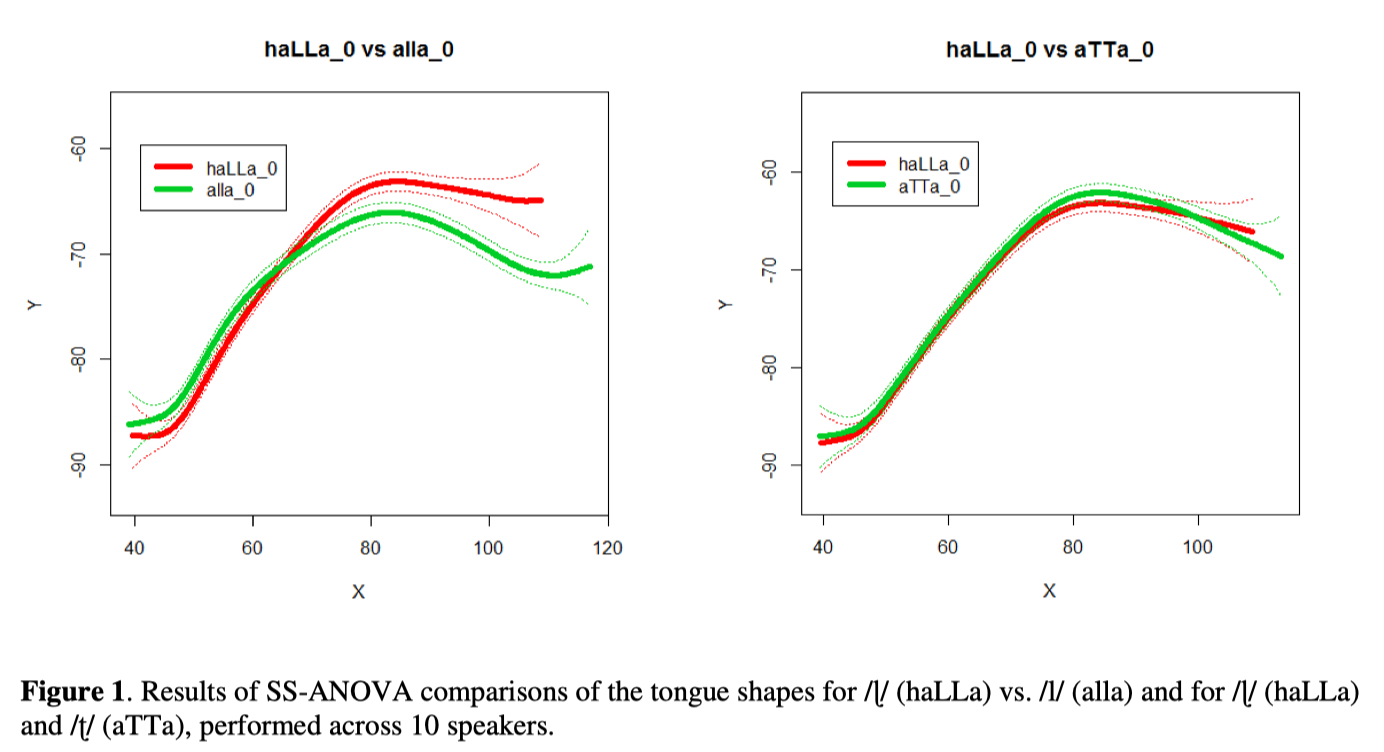
The results revealed that, for all 10 speakers, the posterior tongue body (and possibly the root) for /ɭ/ was as advanced as or significantly more advanced than for /l/ (see Figure 1, left). This indicated that /ɭ/-retroflexion was accompanied by some fronting of the tongue body. Acoustically, this was manifested in the consistently higher F2 for /ɭ/ than for /l/ (by 150-300 Hz). A comparison of the tongue shapes for /ɭ/ and /ʈ/ showed no significant differences in the degree of the tongue body fronting (see Figure 1, right). This showed that the more advanced tongue body position is not unique to /ɭ/, but is likely part of the production of Kannada retroflexes in general.
Combined with other studies, the current results point to language-particular differences in the realization of Dravidian laterals: /ɭ/ in Kannada is similar to /ɭ/ in Tamil (the fronted tongue body/root), and different from /ɭ/ in Malayalam (the backed tongue body/root). These articulatory differences, in turn, are consistent with language-specific acoustic differences in laterals: higher F2 for /ɭ/ than /l/ in Kannada (our data) and Tamil (Narayanan et al., 1999), while lower F2 for /ɭ/ than /l/ in Malayalam (Punnoose, 2011).
References
Davidson, L. (2006). Comparing tongue shapes from ultrasound imaging using smoothing spline analysis of variance. Journal of the Acoustical Society of America, 120, 407–415.
Kochetov, A., Sreedevi, N., Kasim, M. & Manjula, R. (2012). A pilot ultrasound study of Kannadalingual articulations. Journal of Indian Speech and Hearing Association, 26, 38–49.
Ladefoged, P., & Bhaskararao, P. (1983). Non-quantal aspects of consonant production: a study ofretroflex sounds. Journal of Phonetics, 11, 291–302.
Li, M., Kambhamettu, C., & Stone, M. (2005). Automatic contour tracking in ultrasound images. Clinical Linguistics and Phonetics, 19, 545–554.
Narayanan, S., Byrd, D. & Kaun, A. (1999). Geometry, kinematics, and acoustics of Tamil liquidconsonants. Journal of the Acoustical Society of America, 106, 1993–2007.
Punnoose, R. 2011. An auditory and acoustic study of liquids in Malayalam. University of Newcastle PhD thesis.
Scobbie, J., Punnoose, R., & Khattab, G. (in press). Articulating five liquids: a single speaker ultrasound study of Malayalam. In Rhotics: New data and perspectives. BU Press, Bozen-Bolzano.