/s/ in Italian-Tyrolean bilingual speakers
/s/ in Italian-Tyrolean bilingual speakers Lorenzo Spreafico Free University of Bozen-Bolzano This paper presents an exploratory UTI-based study on articulatory patterns for /s/C(C) clusters in Italian. More specifically, it focuses on word-initial and word-internal /s/-stop-(liquid) sequences as produced by four Italian/Tyrolean simultaneous and sequential bilingual speakers. The main aim of this research is to establish if the articulatory patterns for /s/ in Italian vary according to the nature and degree of bilingualism of the speaker. In this respect, the first step is to elicit the articulatory patterns for /s/ and assess whether they are influenced by the nature of the consonant(s) that follow(s). The intra-speaker comparison for tongue profiles based on the SS ANOVA approach (Davidson 2006) shows that the consonant triple /p t k/ exert a small coarticulatory effects on /s/ midpoint (Fig. 1a, b, c). The second step is to investigate whether the tongue configurations for /s/ differ systematically according to the position in the word. The comparison between /s/ tongue contours in word-initial and word-internal position displays that the shape of the tongue as well as its location and orientation (Iskarous 2005) are affected (Fig. 2a, b, c). The third step is to examine if /s/ as uttered in word-initial /spr/, /str/ and /skr/ clusters are more retracted than in /sp/, /st/ and /sk/ sequences (Mielke et al. 2010). Smoothing spline estimates and Bayesian confidence intervals applied to the tongue profiles of the four bilinguals do not confirm this hypothesis (Fig. 3a, b, c). The final step is to correlate all data on articulatory patterns and tongue configuration in simultaneous and sequential bilingual speakers and comment on the relationship between degree of bilingualism and variation of articulatory patters. All articulatory data presented in the paper are captured using an Ultrasonix SonixTablet system coupled to a transducer operating at 5-9 MHz and linked t
收录时间:2020-02-06T04:11:22Z
使用资料正文
/s/ in Italian-Tyrolean bilingual speakers
Lorenzo Spreafico
Free University of Bozen-Bolzano
This paper presents an exploratory UTI-based study on articulatory patterns for /s/C(C) clusters in Italian. More specifically, it focuses on word-initial and word-internal /s/-stop-(liquid) sequences as produced by four Italian/Tyrolean simultaneous and sequential bilingual speakers. The main aim of this research is to establish if the articulatory patterns for /s/ in Italian vary according to the nature and degree of bilingualism of the speaker.
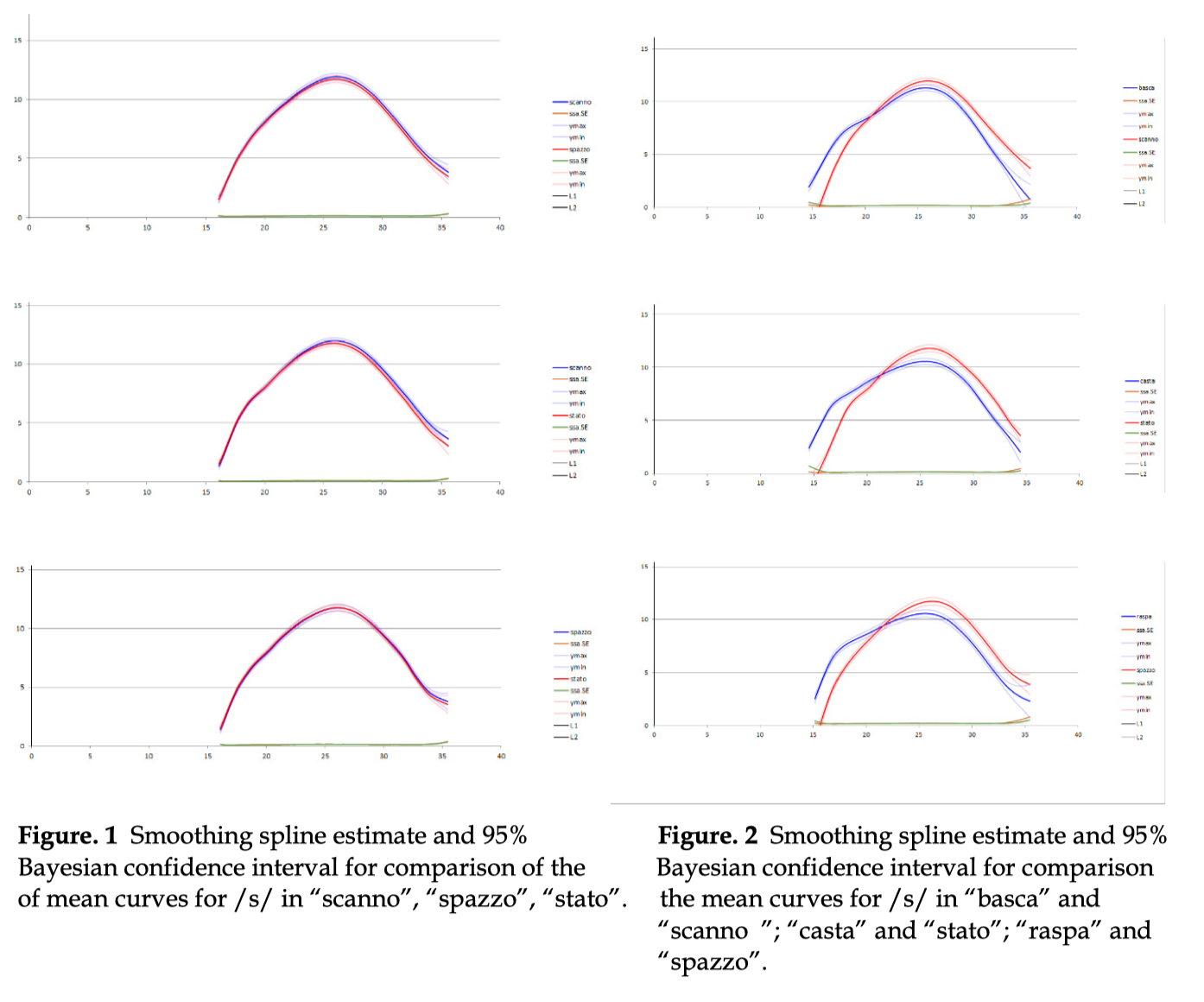
In this respect, the first step is to elicit the articulatory patterns for /s/ and assess whether they are influenced by the nature of the consonant(s) that follow(s). The intra-speaker comparison for tongue profiles based on the SS ANOVA approach (Davidson 2006) shows that the consonant triple /p t k/ exert a small coarticulatory effects on /s/ midpoint (Fig. 1a, b, c).
The second step is to investigate whether the tongue configurations for /s/ differ systematically according to the position in the word. The comparison between /s/ tongue contours in word-initial and word-internal position displays that the shape of the tongue as well as its location and orientation (Iskarous 2005) are affected (Fig. 2a, b, c).
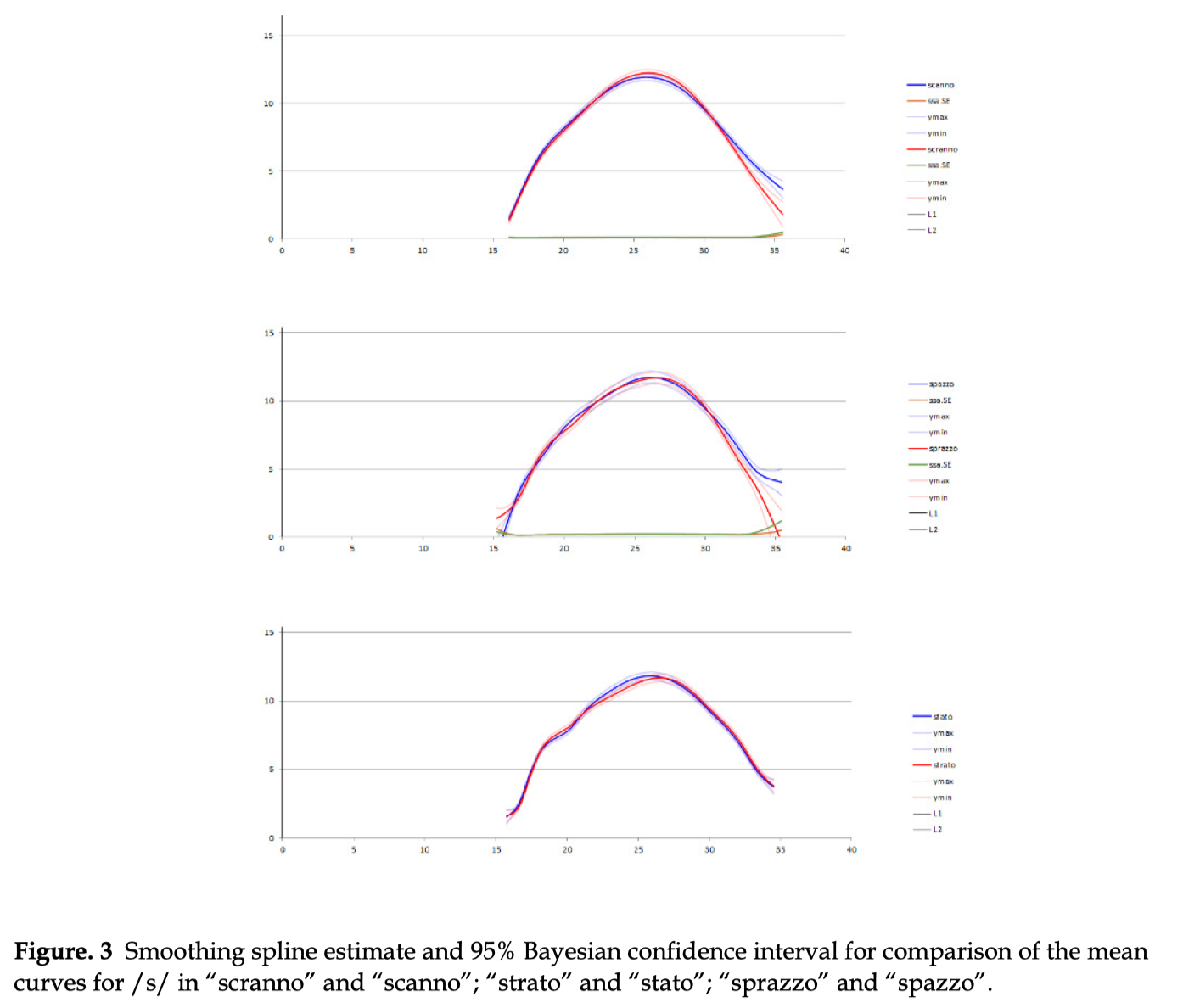
The third step is to examine if /s/ as uttered in word-initial /spr/, /str/ and /skr/ clusters are more retracted than in /sp/, /st/ and /sk/ sequences (Mielke et al. 2010). Smoothing spline estimates and Bayesian confidence intervals applied to the tongue profiles of the four bilinguals do not confirm this hypothesis (Fig. 3a, b, c).
The final step is to correlate all data on articulatory patterns and tongue configuration in simultaneous and sequential bilingual speakers and comment on the relationship between degree of bilingualism and variation of articulatory patters.
All articulatory data presented in the paper are captured using an Ultrasonix SonixTablet system coupled to a transducer operating at 5-9 MHz and linked to the Articulate Instruments AAA software for data acquisition and analysis at a temporal resolution of 122/166Hz.
References
Davidson L. (2006) Comparing tongue shapes from ultrasound imagining using smoothing spline analysis of variance, Journal of the Acoustical Society of America, 120(1): 407-415.
Iskarous K. (2005) Patterns of tongue movement, Journal of Phonetics, 33: 363-381.
Mielke J. et al. (2010) Variability and homogeneity in American English /r/ allophony and /s/ retraction. In Fougeron C. et al (eds.), Variation, Detail, and Representation. Berlin:Mouton de Gruyter: 699-719.