Retroflex versus bunched /r/ in ultrasound intervention: One shape does not fit all?
Retroflex versus bunched /r/ in ultrasound intervention: One shape does not fit all? Tara McAllister Byun1 and Elaine R. Hitchcock2 1. NYU 2. Montclair State University Errors in speech sound production can have a negative impact on children’s development across academic, social, and psycho-emotional domains. While most children go on to attain age-appropriate speech production, an estimated 30% of English-speaking children with a history of speech sound disorder continue to misproduce rhotic sounds at 9 years of age, and 9% still show these errors from 1218 years and beyond (Lewis & Shriberg, 1994). Clinicians have called for more effective treatment methods for residual speech errors, especially for the phoneme /r/ (RSE-/r/). Several descriptive studies have suggested that ultrasound biofeedback can succeed in eliminating /r/ errors that have not responded to other forms of intervention (Adler-Bock et al., 2007; Modha et al., 2008; Bernhardt et al., 2008). There is a need to follow up on these promising results with systematic, controlled studies in order to build an evidence base to support the use of ultrasound biofeedback for RSE. This two-part study aimed to use single-subject experimental methods to systematically measure response to ultrasound biofeedback therapy. Participants in Study 1 were four monolingual English-speaking children, ages 6;1-10;3, who produced /r/ at the word level with less than 30% accuracy but otherwise showed normal speech, language, and hearing abilities. In a multiple-baseline across-subjects design, participants began in a no-treatment baseline phase whose duration increased by one session for each successive client enrolled. Participants then received biofeedback intervention in twice-weekly 30-minute sessions for 8 weeks. In treatment sessions, participants produced 60 trials of /r/ at the syllable level while viewing an ultrasound image generated with an Interson SeeMore USB probe. Both consonantal and vocalic variants of /r/ we
收录时间:2020-02-06T06:29:35Z
使用资料正文
Retroflex versus bunched /r/ in ultrasound intervention:
One shape does not fit all?
Tara McAllister Byun1 and Elaine R. Hitchcock2
1. NYU 2. Montclair State University
Errors in speech sound production can have a negative impact on children’s development across academic, social, and psycho-emotional domains. While most children go on to attain age-appropriate speech production, an estimated 30% of English-speaking children with a history of speech sound disorder continue to misproduce rhotic sounds at 9 years of age, and 9% still show these errors from 1218 years and beyond (Lewis & Shriberg, 1994). Clinicians have called for more effective treatment methods for residual speech errors, especially for the phoneme /r/ (RSE-/r/). Several descriptive studies have suggested that ultrasound biofeedback can succeed in eliminating /r/ errors that have not responded to other forms of intervention (Adler-Bock et al., 2007; Modha et al., 2008; Bernhardt et al., 2008). There is a need to follow up on these promising results with systematic, controlled studies in order to build an evidence base to support the use of ultrasound biofeedback for RSE. This two-part study aimed to use single-subject experimental methods to systematically measure response to ultrasound biofeedback therapy.
Participants in Study 1 were four monolingual English-speaking children, ages 6;1-10;3, who produced /r/ at the word level with less than 30% accuracy but otherwise showed normal speech, language, and hearing abilities. In a multiple-baseline across-subjects design, participants began in a no-treatment baseline phase whose duration increased by one session for each successive client enrolled. Participants then received biofeedback intervention in twice-weekly 30-minute sessions for 8 weeks. In treatment sessions, participants produced 60 trials of /r/ at the syllable level while viewing an ultrasound image generated with an Interson SeeMore USB probe. Both consonantal and vocalic variants of /r/ were targeted in each session. Participants received verbal cues encouraging them to match their tongue shape to a static ultrasound image representing a bunched /r/ tongue shape.
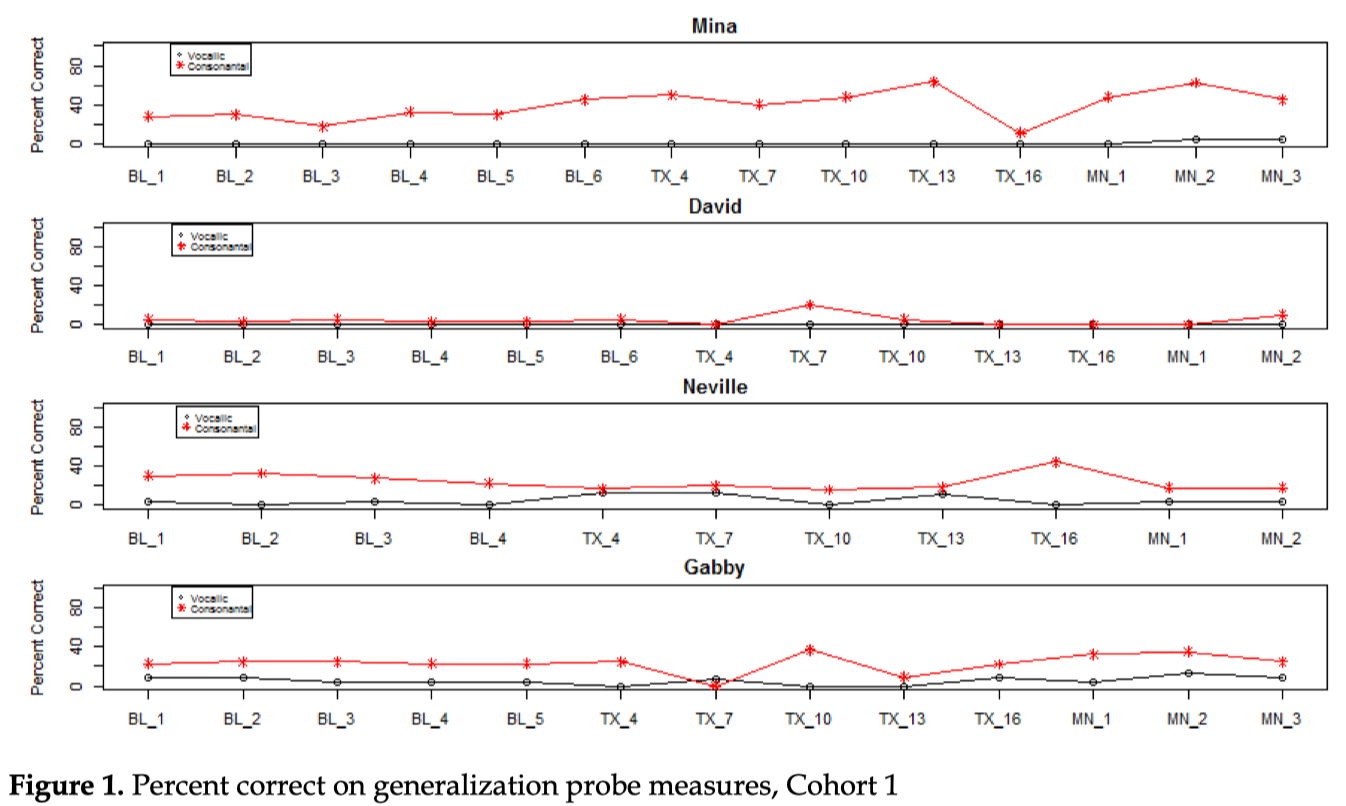
To measure progress, all /r/ trials elicited during baseline, within-treatment, and maintenance probes were isolated and presented in a randomized, de-identified fashion for rating by clinician listeners. Interrater agreement exceeded 88%. Individual trajectories of accuracy over time are depicted in Figure 1. Effect sizes measuring the change from baseline to maintenance period ranged from -1.4 to 2.2 (mean = 0.6), revealing generalization gains of disappointingly small magnitude. Even within the treatment setting, visual inspection of blinded ratings revealed that only one participant (“Gabby”, age 10;3) made substantial, sustained gains. A second study was thus undertaken to determine whether a modified treatment protocol could enhance the gains produced by ultrasound biofeedback. The modification of the study was inspired by an observation about the participant who improved during Study 1: her progress occurred after she happened to produce a retroflex tongue shape which yielded a perceptually accurate /r/. The clinician then reinforced this tongue shape instead of using the standard cues for bunched /r/, and “Gabby’s” accuracy increased steadily, reaching a maximum of 48% within the treatment setting. Thus, it was speculated that outcomes could be improved by using individualized tongue shape targets.
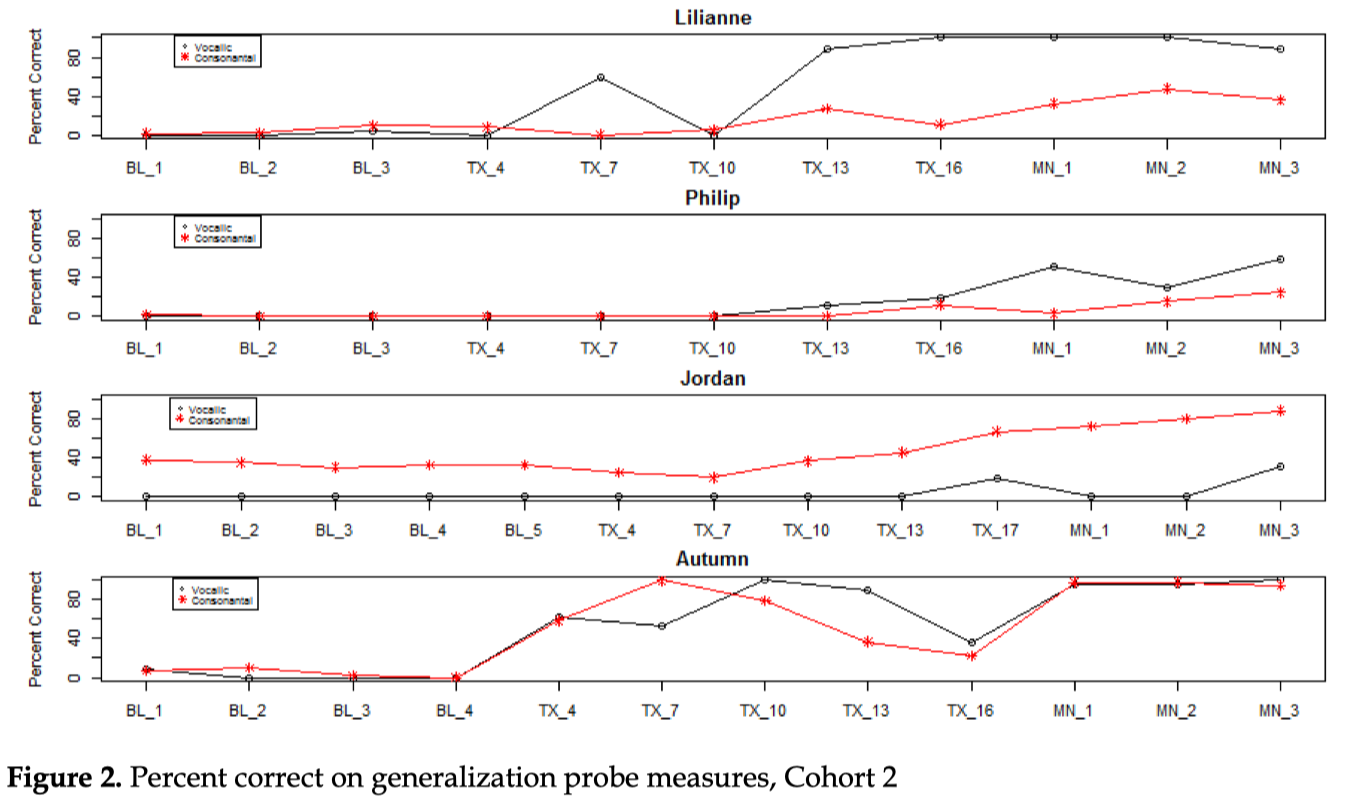
Study 2 enrolled a new group of four children, ages 7;8-15;8, who met the same criteria outlined for Study 1. The same multiple-baseline across-subjects design was used, and treatment followed the same protocol, with one exception: prior to the first treatment session, an ultrasound recording of a contextual /r/ probe was created for each child. Based on the shape of the tongue during the child’s closest /r/ approximations, a candidate tongue shape was selected from among the MRI images collected by Tiede et al. (2004). A retroflex tongue shape was selected as a primary target for one participant and a bunched tip-up shape was targeted for two participants; for the fourth participant, retroflex and bunched shapes were judged to be equally facilitative. Outcomes, again measured with blinded clinician ratings, differed dramatically from Study 1. Across individuals and treatment targets (consonantal vs vocalic /r/), effect sizes ranged from 1.0 to 16.7, with a mean of 7.3. Individual trajectories are depicted in Figure 2.
These two studies do not constitute a controlled comparison of ultrasound treatment with and without the option to select individualized tongue shapes. Other differences, such as the older mean age of participants or the greater experience of the treating clinician in Study 2, may have contributed to the observed difference in outcomes. This research must be followed up in a more systematic fashion before strong conclusions can be drawn. Still, our results offer a strong suggestion that ultrasound biofeedback treatment for RSE-/r/ should include opportunities to explore different tongue shapes in order to find the best fit for the vocal tract characteristics of the individual child.
References
Adler-Bock, M., Bernhardt, B. M., Gick, B., & Bacsfalvi, P. (2007). The use of ultrasound in remediation of North American English /r/ in 2 adolescents. American Journal of Speech-Language Pathology, 16, 128-139.
Bernhardt, B., et al. (2008). Ultrasound as visual feedback in speech habilitation: Exploring consultative use in rural British Columbia, Canada. Clinical Linguistics and Phonetics, 22, 149-162.
Modha, G., et al. (2008). Case study using ultrasound to treat /r/. International Journal of Language & Communication Disorders, 43, 323-329.
Lewis, B. A., & Shriberg, L. D. (1994). Life span interrelationships among speech, prosody-voice, and nontraditional phonological measures. Miniseminar presented at the ASHA convention, New Orleans, LA.
Tiede, M. K., Boyce, S. E., Holland, C. K., & Choe, K. A. (2004). A new taxonomy of American English /r/ using MRI and ultrasound. Journal of the Acoustical Society of America, 115, 2633-2634.