Segment Constants and Speaker Constants in English Coronal Obstruents
Segment Constants and Speaker Constants in English Coronal Obstruents Simon Gonzalez, Mark Harvey, Susan Lin, Katherine Demuth Key words: articulation, coronals, tongue body, tongue blade, tongue tip, ultrasound This paper examines the articulation of the coronal obstruents /t, s, θ, tʃ, ʃ/. Previous studies have found that there is variation in the production of coronals (Dart, 1991; Delattre & Freeman, 1968; Reichard et al., 2012; Stone et al., 2012). These studies examined single segments (/r/, /s/). We compared segments with different places and manners of articulation, with the aim of isolating the articulatory correlates of the various coronal places in English. We used ultrasound to examine tongue motion in real time (Bressmann, 2008; Epstein & Stone, 2005). We provide evidence that there is variation in the articulation of coronal obstruents, but this variation is not unconstrained. We found articulatory constants for each segment that held across all speakers. Further, we found that variation was almost entirely inter-speaker and only minimally intra-speaker. We recruited ten female native speakers of Australian English, and recorded them in a soundattenuated testing room. We asked them to listen to pre-recorded sentences and then to repeat each sentence five times. We placed each target word in the carrier sentence “Please, utter X publically”. The target words were tack, sack, Thack, Chack and shack, and with the target sounds /t, s, θ, tʃ, ʃ/ in onset position, respectively. All target sounds were therefore flanked by the vowels, /ə/ and /æ/. We recorded ultrasound mid-sagittal plane images (29.97fps) of target segments with a portable Sonosite 180 Plus ultrasound machine with a C11/7-4 MHz 11-mm broadband curved array transducer. We then fitted tongue contours by using EdgeTrak. We stabilized the probe with an Alan’s headset. This headset allows the probe to be fixed and capture the ultrasound from a constant position in all utterances. We observed sign
收录时间:2020-02-06T08:41:30Z
使用资料正文
Segment Constants and Speaker Constants in English Coronal Obstruents
Simon Gonzalez, Mark Harvey, Susan Lin, Katherine Demuth
Key words: articulation, coronals, tongue body, tongue blade, tongue tip, ultrasound
This paper examines the articulation of the coronal obstruents /t, s, θ, tʃ, ʃ/. Previous studies have found that there is variation in the production of coronals (Dart, 1991; Delattre & Freeman, 1968; Reichard et al., 2012; Stone et al., 2012). These studies examined single segments (/r/, /s/). We compared segments with different places and manners of articulation, with the aim of isolating the articulatory correlates of the various coronal places in English. We used ultrasound to examine tongue motion in real time (Bressmann, 2008; Epstein & Stone, 2005). We provide evidence that there is variation in the articulation of coronal obstruents, but this variation is not unconstrained. We found articulatory constants for each segment that held across all speakers. Further, we found that variation was almost entirely inter-speaker and only minimally intra-speaker.
We recruited ten female native speakers of Australian English, and recorded them in a soundattenuated testing room. We asked them to listen to pre-recorded sentences and then to repeat each sentence five times. We placed each target word in the carrier sentence “Please, utter X publically”. The target words were tack, sack, Thack, Chack and shack, and with the target sounds /t, s, θ, tʃ, ʃ/ in onset position, respectively. All target sounds were therefore flanked by the vowels, /ə/ and /æ/. We recorded ultrasound mid-sagittal plane images (29.97fps) of target segments with a portable Sonosite 180 Plus ultrasound machine with a C11/7-4 MHz 11-mm broadband curved array transducer. We then fitted tongue contours by using EdgeTrak. We stabilized the probe with an Alan’s headset. This headset allows the probe to be fixed and capture the ultrasound from a constant position in all utterances.
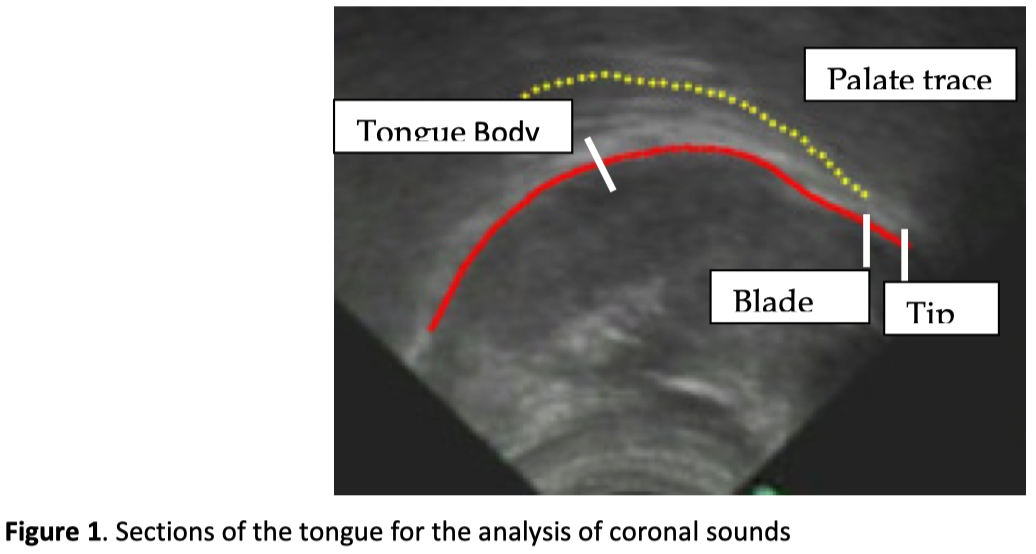
We observed significant differences in the patterns of movement between segments and between speakers in terms of three areas of the ultrasound images. These three areas were (1) the most anterior portion of the images (approx. 5mm), (2) the next most anterior portion of the image (approx. 15mm) and (3) the remainder of the image. We refer to Area 1 as the tip, Area 2 as the blade and Area 3 as the body. We use these terms as the patterns of movement that we observed in these three divisions corresponded to the movements traditionally ascribed to the tip, blade, and body for coronal obstruents.
For each sound, we located the frame which corresponded most closely to maximum constriction (MC). In the MC frame, we examined the position of the tongue body in relation to the front sections: the blade and the tip. We then tracked three frames (100ms) prior to MC and examined which portion of the tongue moved to form MC.
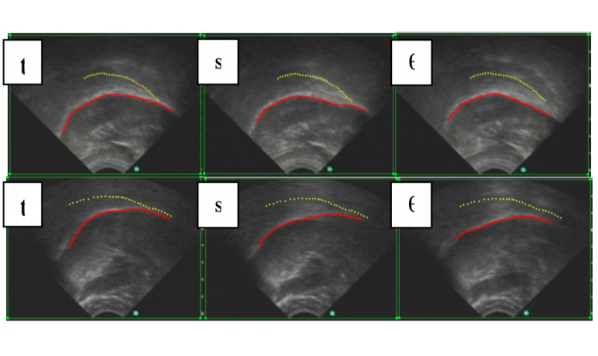
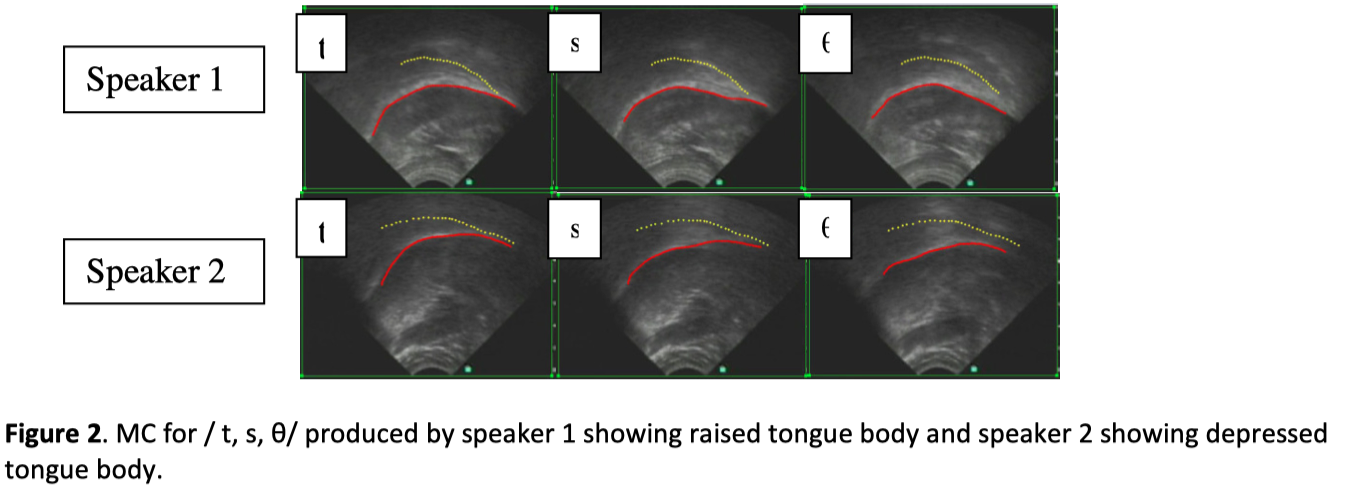
For each place of articulation, there was a segment-specific consistent pattern across speakers of movement into MC. In the case of /t/ and /s/, the tip moved upwards and forward to attain MC. In the case of /θ/, the blade moved forward to attain MC. In the case of /tʃ/ and /ʃ/, the blade moved upwards to attain MC. Then depending on the place of articulation, there was inter-speaker variation in the positioning of the tongue body at MC. For /tʃ/ and /ʃ/ there was no variation – the tongue body was always raised. For /t, s, θ/ there was inter-speaker variation in whether the tongue body was raised or not. For seven speakers the body was raised (see Figure 2). For two speakers the body was lowered in relation to the front part of the tongue (see Figure 2). Only one speaker showed a mixed pattern, where the tongue body was consistently raised for /t/, but not for /s/ and /θ/.
The critical factor predicting inter-speaker consistency appears to be whether the characteristic movement into MC requires also raising the tongue body or not. Raising the blade requires raising the body, and so /tʃ/ and /ʃ/, which both require tongue blade raising, show no inter-speaker variation in this regard. The characteristic movements toward MC for the other coronal obstruents do not require raising the blade. Consequently, there is no segmental conditioning on the position of the tongue body. Our data shows that tongue body position for these coronals does not vary randomly, but rather is constant for a given segment, and usually constant for a given speaker.
References
Bressmann, T. (2008). Quantitative Assessment of Tongue Shape and Movement Using Ultrasound Imaging. Paper presented at the Selected Proceedings of the 3rd Conference on Laboratory Approaches to Spanish Phonology, Somerville, MA.
Dart, S. (1991). Articulatory and Acoustic Properties of Apical and Laminal Articulations.UCLA Working Papers in Phonetics, 79.
Delattre, P., & Freeman, D. (1968). A dialect study of American R’s by X-ray motion picture.Linguistics, 44, 29-68.
Epstein, M. A., & Stone, M. (2005). The tongue stops here: Ultrasound imaging of the palate.Journal of the Acoustical Society of America, 118(4), 2128-2131.
Reichard, R., et al. (2012). Motion of apical and laminal /s/ in normal and post-glossectomy speakers.Paper presented at the Proceedings of the Acoustics 2012 Hong Kong Conference and Exhibition, Hong Kong, China.
Stone, M., et al. (2012). Frequency of Apical and Laminal /s/ in Normal and Post-glossectomy Patients. Journal of Medical Speech Language Pathology, 20(4), 106-111