The articulation of Scottish Gaelic plain and palatalized consonants
The articulation of Scottish Gaelic plain and palatalized consonants Jae-Hyun Sung1 , Diana Archangeli13 , Ian Clayton12 , Daniel Brenner 1 , Samuel Johnston1 , Michael Hammond1 , Andrew Carnie1 1Department of linguistics, University of Arizona, USA 2Department of linguistics, University of Hong Kong, HK 3Deparment of English, Boise State University, USA Scottish Gaelic (Gàidhlig, henceforth SG) exhibits a rich system of consonant mutation, which is mostly governed by its morphology. For instance, the initial consonant [p] of a SG word bàta ‘boat’ changes to [v] when the word undergoes morphological inflection – e.g., a bhàta ‘his boat’, in which bh is pronounced as [v]. Although consonant mutation in SG is well documented (Macaulay (1992), Ladefoged et al. (1998), Gillies (2002), Stewart (2004)), there is only one experimental, quantitative study on this to date (Archangeli et al. (2011)). Our study is the first attempt to provide an empirical comparison of the articulation of unmutated vs. mutated consonants in SG using ultrasound imaging, focusing on plain (unmutated) vs. palatalized (mutated) consonants. Palatalization appears as one of possible consonant mutation types in SG. Examples of palatalization are described in Table 1, in which (1a) and (1b) represent word-medial cases, and (1c) and (1d) represent word-final ones. Table 1 demonstrates that palatalization occurs in SG for different consonant types, in different syllabic positions, and different morphological contexts. Our study investigates the articulation of plain and palatalized consonants in SG across different consonant types and syllabic positions. Experimental data was collected in Sabhal Mòr Ostaig, a college on the Isle of Skye, in which speakers of the Skye dialect are accessible. Whether plain vs. palatalized consonants differ in terms of articulation was determined based on differences in tongue contours – i.e., differences in the position of the tongue tip and back. Preliminary results from
收录时间:2020-02-06T10:30:10Z
使用资料正文
The articulation of Scottish Gaelic plain and palatalized consonants
Jae-Hyun Sung1 , Diana Archangeli13 , Ian Clayton12 , Daniel Brenner 1 ,
Samuel Johnston1 , Michael Hammond1 , Andrew Carnie1
1Department of linguistics, University of Arizona, USA
2Department of linguistics, University of Hong Kong, HK
3Deparment of English, Boise State University, USA
Scottish Gaelic (Gàidhlig, henceforth SG) exhibits a rich system of consonant mutation, which is mostly governed by its morphology. For instance, the initial consonant [p] of a SG word bàta ‘boat’ changes to [v] when the word undergoes morphological inflection – e.g., a bhàta ‘his boat’, in which bh is pronounced as [v]. Although consonant mutation in SG is well documented (Macaulay (1992), Ladefoged et al. (1998), Gillies (2002), Stewart (2004)), there is only one experimental, quantitative study on this to date (Archangeli et al. (2011)). Our study is the first attempt to provide an empirical comparison of the articulation of unmutated vs. mutated consonants in SG using ultrasound imaging, focusing on plain (unmutated) vs. palatalized (mutated) consonants.
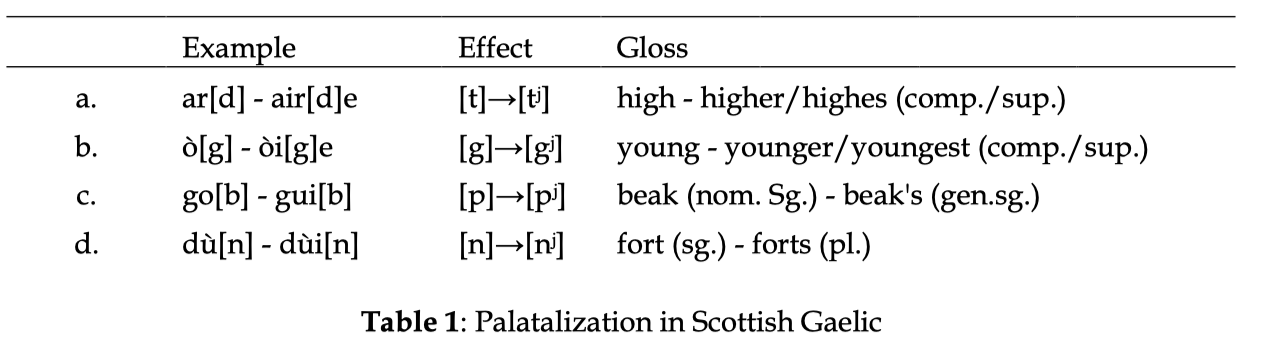
Palatalization appears as one of possible consonant mutation types in SG. Examples of palatalization are described in Table 1, in which (1a) and (1b) represent word-medial cases, and (1c) and (1d) represent word-final ones. Table 1 demonstrates that palatalization occurs in SG for different consonant types, in different syllabic positions, and different morphological contexts.
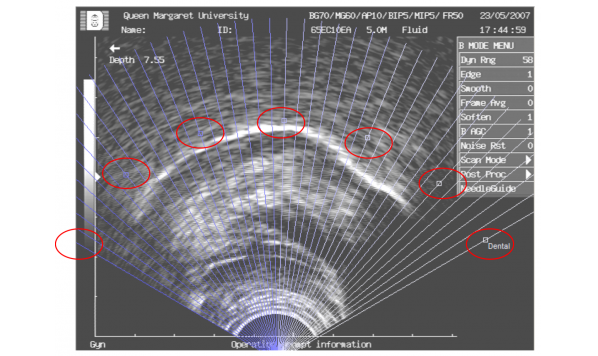
Our study investigates the articulation of plain and palatalized consonants in SG across different consonant types and syllabic positions. Experimental data was collected in Sabhal Mòr Ostaig, a college on the Isle of Skye, in which speakers of the Skye dialect are accessible. Whether plain vs. palatalized consonants differ in terms of articulation was determined based on differences in tongue contours – i.e., differences in the position of the tongue tip and back.
Preliminary results from 4 SG speakers show a clear sign of palatalizsation across different consonant types in palatalization environments (i.e., when morphologically conditioned, often preceded by an orthographic <i>), represented by higher tongue contours in the front region of tongue. While the articulatory distinction between plain and palatalized consonants is significant, different syllabic positions (i.e., word-initial vs. –medial vs. –final palatalization) do not yield any consistent trend in terms of tongue gestures. Although they are based on a small sample of the population, the articulatory patterns of palatalization in different syllabic positions may not manifest as gestural differences.
The overall goal of this study is to look for the articulatory differences giving rise to the perceptual distinctions between plain and palatalized consonants. Furthermore, as part of the Arizona Scottish Gaelic project, the study will complement other components of the project such as statistical corpus analysis and psycholinguistic experimentation.
References
Archangeli, D., Berry, J., Hunt. N., Ji, S., Josephs, K., and Carnie, A. 2011. ATR in Scottish Gaelic tense sonorants: a preliminary report. In Carnie, A., editor, Formal Approaches in Celtic Linguistics, pages 283-306. Cambridge Scholars Publishing.
Gillies, W. 2002 Scottish Gaelic. In Ball, M. and Fife, J., editors, The Celtic Languages, pages 145-227.Routledge.
Ladefoged, P., Ladefoged, J., Turk, A., Hind, K., and Skilton, S. J. 1998. Phonetic structures of Scottish Gaelic. Journal of International Phonetic Association, 28:1-41
Macaulay, D. 1992. The Scottish Gaelic Language. In Macaulay, D., editor, The Celtic Languages, pages 137-248. Cambridge University Press.
Stewart, T. W. 2004. Mutation as morphology: bases, stems, and shapes in Scottish Gaelic. PhD thesis, The Ohio State University.