An Ultrasound Study of the Acquisition of North American English /ɹ/
An Ultrasound Study of the Acquisition of North American English /ɹ/ Lyra Magloughlin University of Ottawa I report an acoustic and articulatory study of North American English /ɹ/ production in typically developing English-speaking children during early- and later-stage acquisition. /ɹ/ is of interest in adult populations because it exhibits acoustic stability (e.g. low F3) despite considerable articulatory variability both within and between speakers (Delattre and Freeman, 1968; Mielke et al., 2010). Adults may use a variety of tongue shapes to achieve this articulatory target, ranging from bunched shapes with the tongue tip pointing down, to more retroflex postures with the tongue tip pointing up. In English-speaking children, /ɹ/ is often one of the last sounds to be acquired, especially in prevocalic position (McGowan et al., 2004). Tiede et al. (2011) have argued that children might attempt different vocal tract configurations during acquisition, particularly in contexts where the articulatory demands are greater. While there is a growing body of literature on articulatory variability in adult production of /ɹ/ (e.g. Mielke et al., 2010; Westbury et al., 1998) there remains virtually no articulatory data on typically developing children’s production during acquisition (although see Davidson et al., 2007, for ongoing research with atypicals). This longitudinal study uses ultrasound imaging to investigate the articulations of four typically developing English-speaking children, aged between 3 and 6 years, during production of familiar lexical items. Children’s early-stage articulations are examined and compared with their laterstage productions, and with adult variability patterns. As illustrated in Figure 1, participants’ adult-like /ɹ/ productions show correspondingly low F3 values (mean: 2540 Hz), as compared with their nearadult-like (mean: 3172 Hz) and non-adult-like (mean: 3573 Hz) productions. These findings are consistent with Dalston (1975), who observe
收录时间:2020-02-06T03:41:13Z
使用资料正文
An Ultrasound Study of the Acquisition of North American English /ɹ/
Lyra Magloughlin
University of Ottawa
I report an acoustic and articulatory study of North American English /ɹ/ production in typically developing English-speaking children during early- and later-stage acquisition. /ɹ/ is of interest in adult populations because it exhibits acoustic stability (e.g. low F3) despite considerable articulatory variability both within and between speakers (Delattre and Freeman, 1968; Mielke et al., 2010). Adults may use a variety of tongue shapes to achieve this articulatory target, ranging from bunched shapes with the tongue tip pointing down, to more retroflex postures with the tongue tip pointing up. In English-speaking children, /ɹ/ is often one of the last sounds to be acquired, especially in prevocalic position (McGowan et al., 2004). Tiede et al. (2011) have argued that children might attempt different vocal tract configurations during acquisition, particularly in contexts where the articulatory demands are greater. While there is a growing body of literature on articulatory variability in adult production of /ɹ/ (e.g. Mielke et al., 2010; Westbury et al., 1998) there remains virtually no articulatory data on typically developing children’s production during acquisition (although see Davidson et al., 2007, for ongoing research with atypicals).
This longitudinal study uses ultrasound imaging to investigate the articulations of four typically developing English-speaking children, aged between 3 and 6 years, during production of familiar lexical items. Children’s early-stage articulations are examined and compared with their laterstage productions, and with adult variability patterns. As illustrated in Figure 1, participants’ adult-like /ɹ/ productions show correspondingly low F3 values (mean: 2540 Hz), as compared with their nearadult-like (mean: 3172 Hz) and non-adult-like (mean: 3573 Hz) productions. These findings are consistent with Dalston (1975), who observed low F3 values (~2500 Hz) in the /ɹ/ productions of his child participants, in keeping with the literature on adult /ɹ/ (Delattre and Freeman, 1968; Ladefoged and Maddieson, 1996). Articulatory results show the children exhibit distinct patterns of /ɹ/ articulation, much like adults in previous studies (e.g. Mielke et al., 2010), and their development is non-deterministic, e.g. twins produce /ɹ/ with completely different (bunched vs. retroflexed) tongue shapes (Figure 2). Further, the children’s exploratory behaviour mirrors adult allophony patterns, with delayed production evident in allophonic contexts that conflict with each child’s dominant tongue posture. For example, one child produced exclusively bunched /ɹ/ in postvocalic and syllabic contexts (Figure 3), and was delayed in prevocalic contexts (where retroflex /ɹ/ is more common among adults) except prevocalically following coronals, which stands out as a context where adults often bunch, even if they retroflex elsewhere (Mielke et al., 2010). Taken together, findings provide compelling evidence to support the notion that the variability we observe with adults emerges in childhood during the exploratory period of acquisition, as suggested by Tiede et al. (2011)
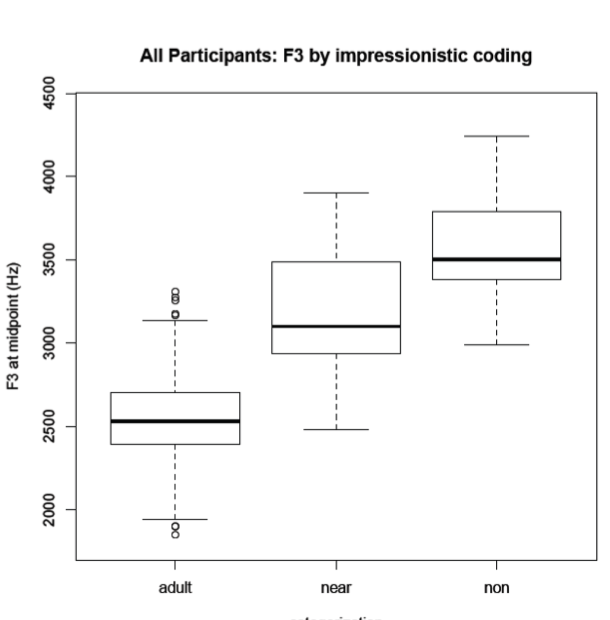
FIGURE 1. Midpoint F3 values for all participants across both Sessions, based on impressionistic categorizations as adult-like, near-adult-like, and non-adult-like.
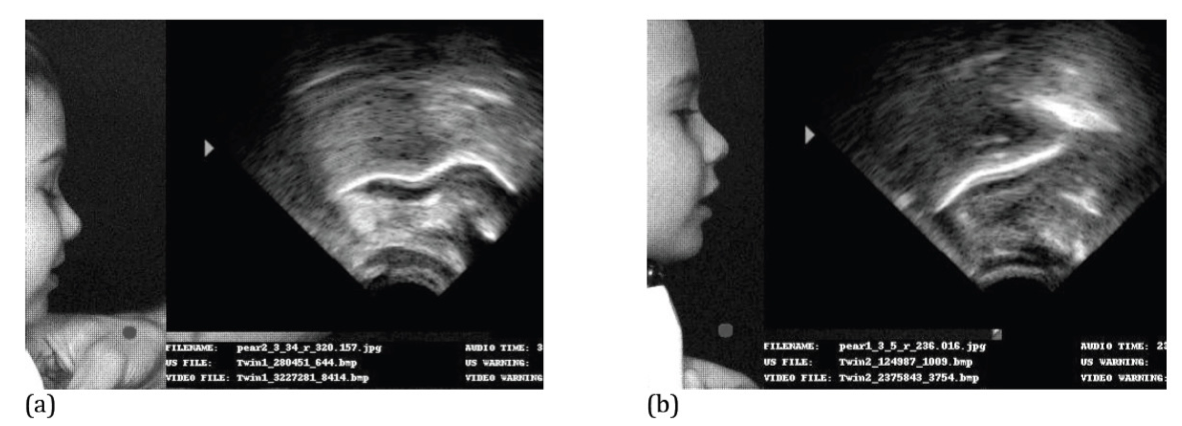
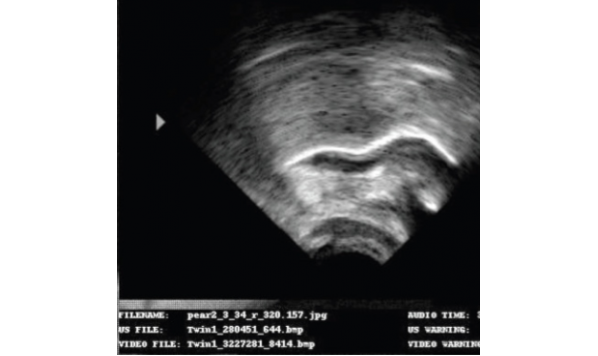
FIGURE 2. Male Twin 1, Session 2, adult-like production of postvocalic /ɹ/ in target word pear (a), exhibiting a bunched/tip down tongue posture, and Male Twin 2, Session 2, adult-like production of postvocalic /ɹ/ in target word pear (b), exhibiting a retroflex/tip up tongue posture.
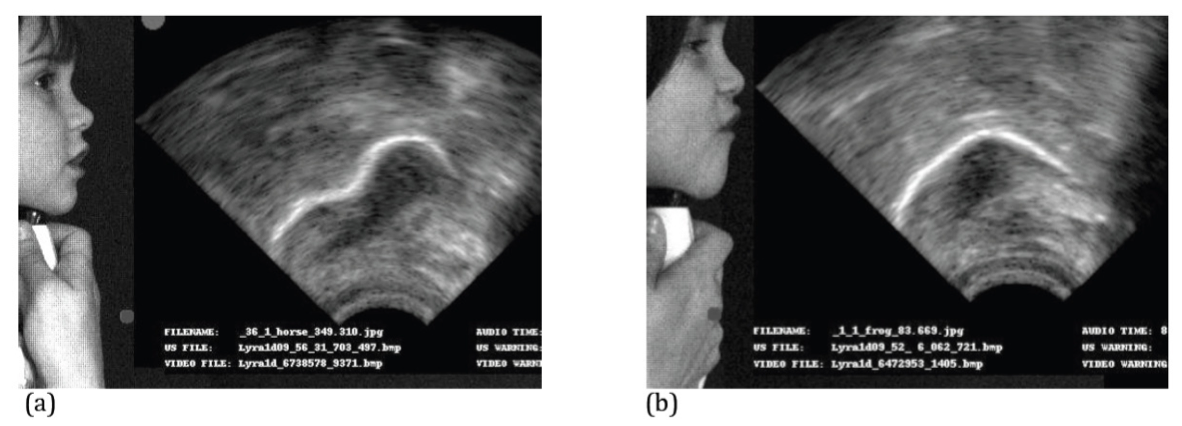
FIGURE 3. Female 1, Session 1, adult-like production of postvocalic /ɹ/ in target word horse (a) exhibiting concavity at the tongue dorsum and a bunched/tip down posture, and Female 1, Session 1, non-adult-like production of prevocalic post-labial /ɹ/ in target word frog (b) showing a backing of the tongue body and constriction at the velum.
References
Dalston, R. (1975). Acoustic characteristics of English /w,r,l/ spoken correctly by young children and adults. Journal of the Acoustical Society of America, 57:462–469.
Davidson, L., Klein, H., and Grigos, M. (2007). Perceptual, kinematic, and ultrasound measurement of /r/ development in children with phonological delay. Ultrafest IV, September 28-29, 2007, NYU.
Delattre, P. & Freeman, D. (1968). A dialect study of American r’s by x-ray motion picture. Linguistics,44:29–68.
Ladefoged, P. & Maddieson, I. (1996). The Sounds of the World’s Languages. Cambridge, MA: Blackwell. McGowan, R.S., Nittrouer, S., & Manning, C.J. (2004). Development of [r] in young, Midwestern,American children. Journal of the Acoustical Society of America, 115(2), 871-884.
Mielke, J., Baker, A. and Archangeli, D. (2010). Variability and homogeneity in American English /ɹ/ allophony and /s/ retraction. In Variation, Detail, & Representation. Berlin: Mouton de Gruyter. Tiede, M.K., Boyce, S.E., Espy-Wilson, C.Y. and Gracco. V.L. (2011). Variability of North American English/r/ production in response to palatal perturbation. In Speech motor control: New developments in basic and applied research, ed. Ben Maassen and Pascal van Lieshout, 53-67. Oxford: Oxford University Press.
Westbury, J., Hashi, M. and Lindstrom, M. (1998). Differences among speakers in lingual articulation for American English /ɹ/. Speech Communication, 26:203-226.