Can seeing help you hear? Acoustic vs. Ultrasound information in the diagnosis of speech sound disorders associated with cleft palate
Can seeing help you hear? Acoustic vs. Ultrasound information in the diagnosis of speech sound disorders associated with cleft palate Zoe Roxburgh, James, M. Scobbie, Joanne Cleland and Sara Wood CASL, Queen Margaret University Many studies investigating speech characteristics in cleft palate (CP) have been based on perceptual analysis. In most cases, phonetic transcription is deemed to be gold standard in diagnosing speech sound disorders associated with cleft palate (Sell 2005). Due to the heterogeneity and complexity of CP, atypical and compensatory articulations may not be identified through phonetic transcription alone. For speech and language therapists using phonetic transcription, there is a risk of these unusual patterns being unidentified, with possible misdiagnosis and subsequent inappropriate intervention. Technological advances allow for a more detailed assessment of cleft palate speech, using instrumental techniques. One such tool, Electropalatography (EPG), indirectly shows the effects of the cleft using a standardised palate for those with typical, or in the case of CP, atypical, palate shapes and sizes. Howard (2004) investigated the compensatory articulations in adolescents with cleft palate using perceptual and EPG information. It was concluded that information provided by EPG allowed insight into a range of atypical patterns which were unidentified during phonetic transcription alone. A more recent tool, ultrasound tongue imaging (UTI), also shows the indirect effect of the cleft on speech. As UTI shows the surface of the tongue from nearly the tip to the root, it is particularly useful for looking at backing (Stone 2005), a common compensatory articulation in CP speech (PetersonFalzone et al. 2010). Gibbon and Wolters (2005) and Bressmann, Radovanovic, Kulkarni, Klaiman and Fisher (2011) have explored the compensatory articulations in CP speech using UTI and have concluded that it has the potential to become a useful tool for investigating cleft
收录时间:2020-02-06T06:41:32Z
使用资料正文
Can seeing help you hear? Acoustic vs. Ultrasound
information in the diagnosis of speech sound disorders
associated with cleft palate
Zoe Roxburgh, James, M. Scobbie, Joanne Cleland and Sara Wood
CASL, Queen Margaret University
Many studies investigating speech characteristics in cleft palate (CP) have been based on perceptual analysis. In most cases, phonetic transcription is deemed to be gold standard in diagnosing speech sound disorders associated with cleft palate (Sell 2005). Due to the heterogeneity and complexity of CP, atypical and compensatory articulations may not be identified through phonetic transcription alone. For speech and language therapists using phonetic transcription, there is a risk of these unusual patterns being unidentified, with possible misdiagnosis and subsequent inappropriate intervention.
Technological advances allow for a more detailed assessment of cleft palate speech, using instrumental techniques. One such tool, Electropalatography (EPG), indirectly shows the effects of the cleft using a standardised palate for those with typical, or in the case of CP, atypical, palate shapes and sizes. Howard (2004) investigated the compensatory articulations in adolescents with cleft palate using perceptual and EPG information. It was concluded that information provided by EPG allowed insight into a range of atypical patterns which were unidentified during phonetic transcription alone.
A more recent tool, ultrasound tongue imaging (UTI), also shows the indirect effect of the cleft on speech. As UTI shows the surface of the tongue from nearly the tip to the root, it is particularly useful for looking at backing (Stone 2005), a common compensatory articulation in CP speech (PetersonFalzone et al. 2010). Gibbon and Wolters (2005) and Bressmann, Radovanovic, Kulkarni, Klaiman and Fisher (2011) have explored the compensatory articulations in CP speech using UTI and have concluded that it has the potential to become a useful tool for investigating cleft palate speech. In addition, Zharkova (2013) has identified ultrasound as a potentially useful tool for the assessment of speech in speakers with CP. However its clinical applications remain to be tested, particularly as a biofeedback tool in intervention.
The current study tests and compares the clinical application of articulatory animations and UTI for speech sound disorders in children with a repaired cleft palate. One key aspect of this study is to identify whether ultrasound confirms phonetic transcriptions and if it provides any additional information on the compensatory articulations in CP speech described in the literature.
This study uses a single-subject multiple-baseline design. Participants are three males, ages 6;3, 6;7 and 9;2, with a secondary speech sound disorder as a result of repaired CP.
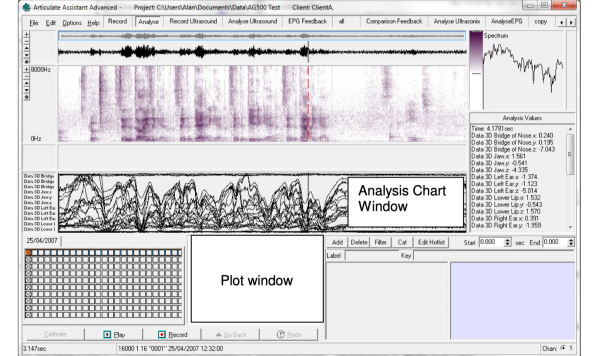
Participants received two assessment sessions, in which the phonology subtest of the Diagnostic Evaluation of Articulation and Phonology (DEAP) (Dodd et al. 2002) and phoneme-specific wordlists were administered and recorded using an Ultrasonix® SonixRP machine remotely controlled via Ethernet from a PC running Articulate Assistant Advanced™ software (AAA) (Articulate Instruments 2010). A headset was used to stabilise the probe, to ensure accurate measurements were gathered. To ensure that headset movement was accounted for, a video from a headset-mounted micro-camera was used, which also captured lip data. A headset-mounted microphone was also used to record audio data.
A narrow transcription of speech data was carried out by two phonetically trained listeners, using symbols from the International Phonetic Alphabet chart and the Extended International Alphabet chart. Lip data was taken into consideration for perceptual analysis. Ultrasound data was analysed using AAA software version 2.14 (Articulate Instruments 2010).
Phonetic transcriptions and ultrasound data were analysed in detail for speaker 2, a 6 year old male with repaired submucous cleft. Phonetic transcriptions of the DEAP and phoneme-specific wordlists revealed cleft type characteristics such as backing of alveolar and velar to glottal place of articulation, velopharyngeal friction and possible double articulations. A preliminary analysis of ultrasound data confirmed phonetic transcriptions of speaker 2. It also revealed covert errors such as double articulations of alveolar-glottal stops. Lip data revealed additional silent labial articulations. A detailed analysis of findings from speaker 2 will be presented.
References:
Articulate Assistant Advanced Ultrasound Module User Manual, 2010. Revision 212, Articulate Instruments Ltd.
Bressmann, T., Radovanovic, B., Kulkarni, G. V., Klaiman, P., and Fisher, D. 2011. An ultrasonographic investigation of cleft-type compensatory articulations of voiceless velar stops. Clinical Linguistics & Phonetics. Vol. 25(11-12) pp.1028-1033.
Dodd, B., Hua, Z., Crosbie, S., Holm, A., and Ozanne, A. 2002. Diagnostic Evaluation of Articulation and Phonology. London: The Psychological Corporation.
Gibbon, F.E. and Wolters, M. 2005. A new application of ultrasound to image tongue behaviour in cleft palate speech. Poster presentation at the Craniofacial Society of Great Britain and Ireland Annual Scientific Conference, Swansea, UK (13-15 April 2005).
Howard, S. 2004. Compensatory articulatory behaviours in adolescents with cleft palate: comparing the perceptual and instrumental evidence. Clinical Linguistics & Phonetics. Vol 18. pp. 313-340.
Peterson-Falzone, S.J., Hardin-Jones, M.A., and Karnell, M.P. 2010. Cleft Palate Speech. 4 th ed. United States: Mosby, Elsevier.
Sell, D. 2005. Issues in perceptual speech analysis in cleft palate and related disorders: a review. International Journal of Language and Communication Disorders. Vol 40(2). pp.103-121.
Stone, M. 2005. A guide to analysing tongue motion form ultrasound images. Clinical Linguistics & Phonetics. Vol.19(6/7) pp.455-501.
Zharkova, N. 2013. Using ultrasound to quantify tongue shape and movement characteristics. The Cleft Palate-Craniofacial Journal. Vol 50. pp 76-81.