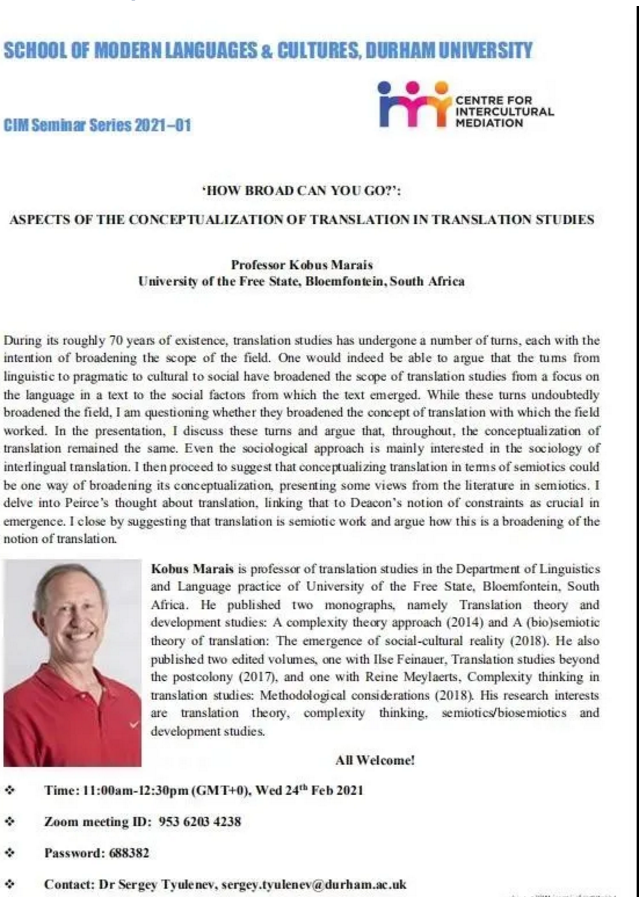
2021年2月24号11:00-12:30—Professor Kobus Marais—HOW BROAD CAN YOU GO?’:ASPECTS OF THE CONCEPTUALIZATION OF TRANSLATION IN TRANSLATION STUDIES
HOW BROAD CAN YOU GO?’:ASPECTS OF THE CONCEPTUALIZATION OF TRANSLATION IN TRANSLATION STUDIES Professor Kobus Marais 2021年2月24号11:00-12:30Professor Kobus Marais University of the F…
会议信息
- 活动类型
- 学术活动
- 时间状态
- 往期回顾
- 开始时间
- 2021-02-24 11:00
- 结束时间
- 2021-02-24 12:30
- 地点
- Zoom meeting ID: 953 6203 4238 Password: 688382
- 举办方式
- 线上
- 主讲人
- Professor Kobus Marais
- 研究方向
- 英语语言学
日程与征稿
Professor Kobus Marais
2021年2月24号11:00-12:30Professor Kobus Marais
University of the Free State, Bloemfontein, South Africa
During its roughly 70 years of existence, translation studies has undergone a number of turns, each with the intention of broadening the scope of the field. One would indeed be able to argue that the turns from linguistic to pragmatic to cultural to social have broadened the scope of translation studies from a focus on the language in a text to the social factors from which the text emerged. While these turns undoubtedly broadened the field, I am questioning whether they broadened the concept of translation with which the field worked. In the presentation, I discuss these turns and argue that, throughout, the conceptualization of translation remained the same. Even the sociological approach is mainly interested in the sociology of interlingual translation. I then proceed to suggest that conceptualizing translation in terms of semiotics could be one way of broadening its conceptualization, presenting some views from the literature in semiotics. I delve into Peirce’s thought about translation, linking that to Deacon’s notion of constraints as crucial in emergence. I close by suggesting that translation is semiotic work and argue how this is a broadening of the notion of translation.
Kobus Marais is professor of translation studies in the Department of Linguistics and Language practice of University of the Free State, Bloemfontein, South Africa. He published two monographs, namely Translation theory and development studies: A complexity theory approach (2014) and A (bio)semiotic theory of translation: The emergence of social-cultural reality (2018). He also published two edited volumes, one with Ilse Feinauer, Translation studies beyond the postcolony (2017), and one with Reine Meylaerts, Complexity thinking in translation studies: Methodological considerations (2018). His research interests are translation theory, complexity thinking, semiotics/biosemiotics and development studies.