2020年11月4日Padraic Monaghan教授-官方讲座视频回放+讲座PPT-How are vocabulary and grammar acquired? Insights from artificial language learning studies
4 November 2020 (20:00 HK time) How are vocabulary and grammar acquired? Insights from artificial language learning studies Padraic Monaghan (Lancaster University) 讲座PPT查看和地址下载: ht…

会议信息
- 活动类型
- 学术讲座
- 时间状态
- 往期回顾
- 开始时间
- 2020-11-04 16:27
- 结束时间
- 2020-11-04 16:27
- 举办方式
- 未注明
- 主办方
- 香港中文大学语言处理实验室
- 研究方向
- 大脑与认知科学
日程与征稿
4 November 2020 (20:00 HK time)
How are vocabulary and grammar acquired? Insights from artificial language learning studies
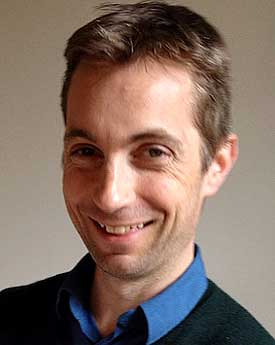
Padraic Monaghan (Lancaster University)
讲座PPT查看和地址下载:
https://osf.io/ewx8p/
视频回放密码及地址:
(password:f5#S1e^9)
https://cuhk.zoom.us/rec/share/D7V1u0jQR2Ncp2ayo1sokQNskHdOgc-apUjCnWF427b7kQ3sKqTRQHWUbQiPi8K6.m7ndWQSbHirAWz90
Contact Details
- Department: Psychology
- TelTelephone:
- p.monaghan@lancaster.ac.uk
-
Profile
I am Professor of Cognition in the Department of Psychology at Lancaster University. I have a BSc (Mancun) in Philosophy and Maths, an MSc and a PhD (Edinburgh) in Cognitive Science. I have previously held posts at Edinburgh University, University of Warwick, University of York, and the University of Amsterdam. My work sits at the intersection of Psychology and Linguistics, and I use methods including behavioural and observational studies and computational modelling to investigate language and cognition.
My name is pronounced "pad+rick mon-uh-hun" (unless you're Irish and you know better).
Research Interests
Language acquisition, literacy, and language evolution
I am interested in children's early environment supports their language development. In particular, how phonology, prosody, gesture, distribution of words, and wider environmental information sources are combined by the child as she/he constructs knowledge of words and grammar.
I am also interested in how early language development influences literacy development, and how children's oral language skills relate to the effectiveness of different types of reading training.
I am also interested in the properties of languages that assist in learning - because languages change quickly, there is lots of scope for dialects that are easier to learn to be selected over dialects that are harder to learn. I plot the extent to which these learnability properties are embedded within the world's languages and can be tracked through diachronic studies of language change.
Sleep
Thanks to my excellent lab group and generations of talented students, I have become intrigued by how sleep affects learning, memory, and problem solving. Kekule's famous discovery of the structure of Benzene during a dream seems to reflect a general truth: sleeping on it really does help.