2021/06/22 9:00—English Women’s Entrance into Science and Philosophy
English Women’s Entrance into Science and Philosophy 主办单位:上财外国语学院 主讲人:Lisa Walters 讲座时间:2021/06/22 9:00 Zoom 会议:853 266 82902 密码:210622 This lecture will be co-hosted by the Litera…

会议信息
- 活动类型
- 学术活动
- 时间状态
- 往期回顾
- 开始时间
- 2021-06-22 08:57
- 结束时间
- 2021-06-22 15:57
- 举办方式
- 未注明
- 研究方向
- 英语语言学
日程与征稿
English Women’s Entrance into Science and Philosophy
主办单位:上财外国语学院
主讲人:Lisa Walters
讲座时间:2021/06/22 9:00
Zoom 会议:853 266 82902
密码:210622
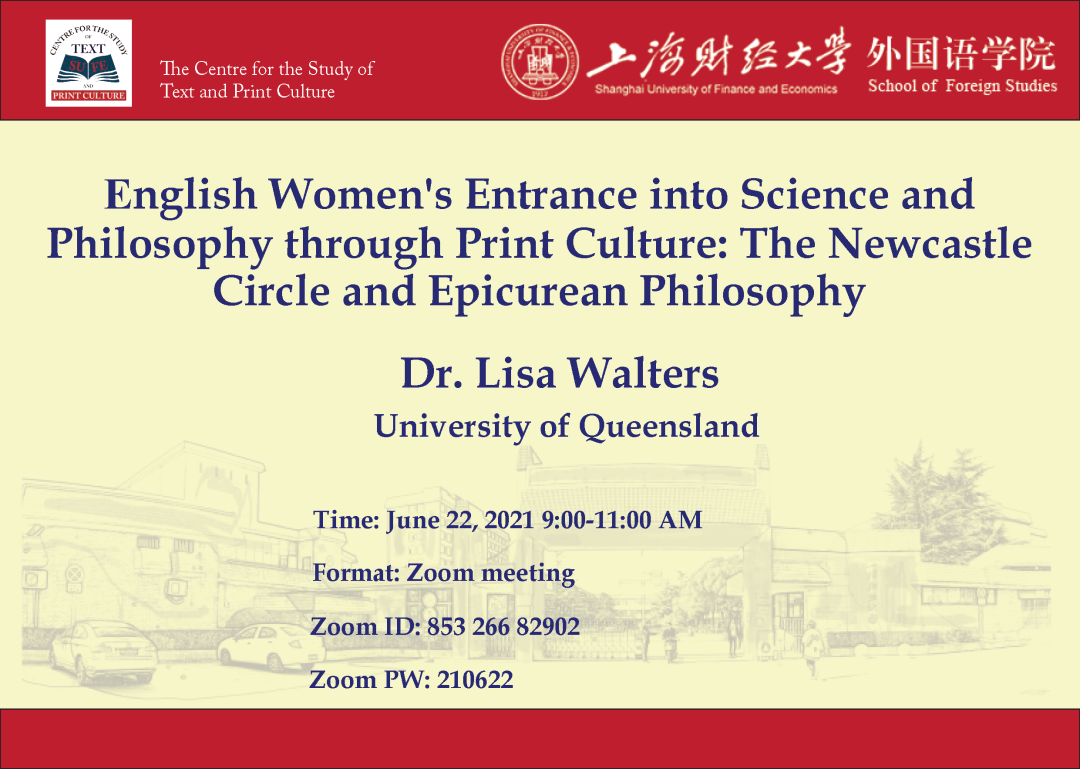
This lecture will be co-hosted by the Literature Team of the School of Foreign Studies and the SUFE Centre for the Study of Text and Print Culture
讲座摘要/ Abstract
Scholarship has increasingly been investigating the important role of Epicurean philosophy within the Renaissance intellectual milieu. The dissemination of Epicurean ideas in England was very fragmentary and it was not until the 1650s that atomism, inspired by Epicurus, became a pervasive public factor in the development of the English sciences. The Newcastle circle was particularly instrumental in rekindling Epicurean philosophy throughout Europe during the mid-seventeenth century. Scholarship, however, has overlooked how English members of the Newcastle circle such as Walter Charleton, Thomas Hobbes and Margaret Cavendish assimilated and modified Epicurean ideas, thereby contributing to significant changes in the intellectual landscape and print culture of seventeenth-century Britain. This included an increased interest by women to print their ideas about natural philosophy. Although English women had engaged with science and philosophy in manuscripts, letters and salons, their engagement rarely manifested into print. Catherine Wilson notes that women such as Margaret Cavendish, Lucy Hutchinson, and Aphra Behn, however, became drawn to Epicurean philosophy in their published works, but the “attraction of women to Epicureanism is a topic that has been little explored and even less explained.” Indeed, scholarship, to date, has neglected the significant role that women had in introducing Epicurean atomism to Britain through print. This talk aims to address this neglected issue, as it investigates the ways that Charleton, Hobbes, and Margaret Cavendish explore a central element of Epicurean philosophy: pleasure. In doing so, these thinkers reconsider the meaning of justice, marriage and sexuality in ways that opened up different avenues for conceptualizing gender, which may have been appealing to women intellectuals. Hence, this talk will argue not only that the Newcastle circle was influential in paving the way for women’s broader participation in science and philosophy in print, but also that their exploration of Epicurean ethics held significant implications for gender.
主讲人简介/ CV

Lisa Walters is a Senior Lecturer at the University of Queensland, Australia. Her monograph entitled Margaret Cavendish: Gender, Science and Politics was published by Cambridge University Press in 2014 and in paperback 2017. She is co-editor of Margaret Cavendish: An Interdisciplinary Perspective (Cambridge University Press, forthcoming) and is one of the joint editors of the Restoration section of the Palgrave Encyclopedia of Early Modern Women's Writing. She has published articles on Cavendish, Shakespeare, Milton and early modern women in relation to science, philosophy, gender and political thought. Dr Walters has held academic positions in England, America, Belgium and Scotland. Recently, she was President of the International Margaret Cavendish Society.
More information to get
SUFE Centres Launch Ceremony
SFS新研究中心揭牌仪式系列报道|Excerpts from the Testimonials
TEXT PRINT CULTURE| Hamlet and the Failure of Consolation
TEXT PRINT CULTURE| Guest Lectures for 2021
TEXT PRINT CULTURE| Elizabeth I: Memory and Mortality
TEXT PRINT CULTURE| Frankenstein and Romantic Visual Culture
TEXT PRINT CULTURE| Victorian Industrial Workers and Print Culture
TEXT PRINT CULTURE| Satire's Name Games: What Reader Notations Reveal
TEXT PRINT CULTURE|Approaching Literature: The Historicist and/or the Presentist
TEXT PRINT CULTURE|William Shenstone, Visual-Textual Culture and Relational Media Practices