2021年9月8日— Tim Hunter:Generalising active gap-filling
讲座 Speaker: Tim HunterTitle: Generalising active gap-fillingTime: 15:00 – 16:30, Wed, 8 Sep 2021 (Beijing, Hong Kong time)Venue: https://cuhk.zoom.us/j/779556638 https://cuhk.zoom.…
会议信息
- 活动类型
- 学术活动
- 时间状态
- 往期回顾
- 开始时间
- 2021-09-08 15:00
- 结束时间
- 2021-09-08 16:30
- 举办方式
- 未注明
- 研究方向
- 心理语言学
日程与征稿
讲座
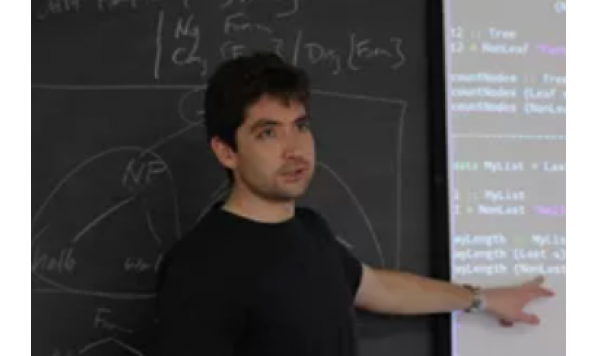
About the speaker Tim Hunter is an Associate Professor in Linguistics at the University of California, Los Angeles. He earned undergraduate degrees in Software Engineering and French at UNSW in Sydney, and completed his PhD in 2010 at the University of Maryland, College Park. His area of specialisation is computational linguistics, with a focus on how the formal study of grammars can help inform the integration of grammatical theory with psycholinguistics.
Generalising active gap-filling
Tim HunterDepartment of Linguistics, UCLA
A central issue in theories of sentence comprehension is the resolution of "long distance" dependencies. An example is the dependency between the fronted wh-phrase and its thematic direct object position in a sentence like "Which book did the teacher give to the student?". Experimental evidence across multiple methodologies indicates that human comprehenders construct these dependencies in a pro-active manner, in advance of bottom-up input that identifies the position of the missing argument ("active gap-filling", Fodor 1978).
A challenge that remains outstanding is fitting these well-known experimental findings into computationally explicit models of sentence processing. Existing models provide a useful framework for understanding the online construction of structurally-local dependencies (e.g. canonical verb-argument dependencies), but are based on parsing algorithms for simple (context-free) phrase-structure grammars, and therefore cannot easily be extended to engage with the psycholinguistic work on long-distance dependencies. Attempts to bridge this divide have generally added specialised machinery that fails to generalise beyond the most familiar cases.
In this talk, I will present a computationally explicit and implementable theory that addresses this challenge, and treats local and non-local dependencies in a unified manner. This proposal adapts core ideas from classical sentence processing models to less simplistic grammars, and correctly predicts some recent experimental findings comparing active gap-filling across verb-final and verb-medial languages.Virtual Psycholinguistics Forum: (https://cuhklpl.github.io/forum.html)
About the speaker Tim Hunter is an Associate Professor in Linguistics at the University of California, Los Angeles. He earned undergraduate degrees in Software Engineering and French at UNSW in Sydney, and completed his PhD in 2010 at the University of Maryland, College Park. His area of specialisation is computational linguistics, with a focus on how the formal study of grammars can help inform the integration of grammatical theory with psycholinguistics.
Generalising active gap-filling
Tim HunterDepartment of Linguistics, UCLA
A central issue in theories of sentence comprehension is the resolution of "long distance" dependencies. An example is the dependency between the fronted wh-phrase and its thematic direct object position in a sentence like "Which book did the teacher give to the student?". Experimental evidence across multiple methodologies indicates that human comprehenders construct these dependencies in a pro-active manner, in advance of bottom-up input that identifies the position of the missing argument ("active gap-filling", Fodor 1978).
A challenge that remains outstanding is fitting these well-known experimental findings into computationally explicit models of sentence processing. Existing models provide a useful framework for understanding the online construction of structurally-local dependencies (e.g. canonical verb-argument dependencies), but are based on parsing algorithms for simple (context-free) phrase-structure grammars, and therefore cannot easily be extended to engage with the psycholinguistic work on long-distance dependencies. Attempts to bridge this divide have generally added specialised machinery that fails to generalise beyond the most familiar cases.
In this talk, I will present a computationally explicit and implementable theory that addresses this challenge, and treats local and non-local dependencies in a unified manner. This proposal adapts core ideas from classical sentence processing models to less simplistic grammars, and correctly predicts some recent experimental findings comparing active gap-filling across verb-final and verb-medial languages.Virtual Psycholinguistics Forum: (https://cuhklpl.github.io/forum.html)